
Showing all 59 resultsSorted by latest

Flower | +/- 1780
€ 80,00A central flower, painted with precise and delicate lines, occupies the centre of the tile and is complemented by the classic spider corner motifs.
In very good condition, with small signs of wear on the sides.

Bird on branch | +/- 1780
€ 60,00This tile from the late 18th century features a flower and a bird in Frisian Delft style, with very delicate strokes in its design. Unlike many other Delft tiles, this one lacks corner motifs, placing full emphasis on the central decoration.
The tile is in good condition, with visible wear on the surface. Hand-painted in cobalt blue on a white tin-glazed surface, it reflects the refined artistry of Friesland’s ceramic traditions. Tiles like this were commonly used to decorate kitchens and fireplaces.

Frisian Flower | +/- 1780
€ 70,00This tile from the late 18th century features a Frisian flower motif, showcasing intricate and delicate floral design. Unlike many other Delft tiles, this one lacks corner motifs, placing full emphasis on the central decoration.
The tile is in very good condition, with only minor wear. Hand-painted in cobalt blue on a white tin-glazed surface, it reflects the refined artistry of Friesland’s ceramic traditions. Tiles like this were commonly used to decorate kitchens and fireplaces.

Tiny House| +/- 1780
€ 70,00Beautiful late 18th-century Delft tile in the tiny decor style. A central house, painted with precise and delicate lines, occupies the centre of the tile, with no corner motifs, emphasising the main design.
In good condition.

Frisian Flower| +/- 1780
€ 50,00Beautiful late 18th-century Delft tile in the tiny decor style. A central flower, painted with precise and delicate lines, occupies the centre of the tile and is complemented by the classic spider corner motifs.
In good condition, with noticeable signs of wear on the sides.

Sea God | +/- 1720
€ 100,00This Delft tile, dating to the 1720s, depicts a merman with his back turned toward the viewer, head partially turned, holding a large staff and wearing a crown. Such fantastical maritime motifs were popular in 18th-century Dutch tilework, reflecting the Netherlands’ rich seafaring culture and the influence of the sea on decorative arts.
The corners feature the classic “spider” motif. This tile is a rare example of elaborate merman imagery, making it highly collectable. It remains in good condition for its age, with some damage along the sides.

Sea Creature | +/- 1720
€ 125,00This Delft tile, dating to around the 1720s, depicts a fantastical sea creature—a hybrid of a marine monster and a terrestrial mammal. Such imaginative motifs were popular in the 17th and early 18th-century Dutch tilework, reflecting the Netherlands’ rich maritime culture and the influence of seafaring life on decorative arts.
The paintwork on this tile is in very good condition. However, the tile misses a corner on the bottom left.

Deer | +/- 1770
€ 60,00This Delft tile from around 1770 features a deer in motion, captured mid-hop. This type of ‘springertjes’ tiles were hugely popular in the second half of the 18th century.
The scene is enclosed within a circular frame, with the corners adorned by the classic “spider” motif. The tile is in good condition for its age, with glaze damage visible along the edges and restoration work present on the surface in the top-right corner.

Windmill | +/- 1750
€ 90,00This Delft tile, dating to around 1750, depicts a windmill surrounded by water and boats. The composition conveys a calm, scenic view, with careful attention to detail.
The corners are adorned with the classic “spider” motif. The tile remains in good condition for its age, with some noticeable damage visible across the surface, consistent with age and use.

Windmill | +/- 1770
€ 75,00This Delft tile, dating to around 1770, depicts a windmill surrounded by water and boats on all sides. The composition conveys a calm, scenic view, with careful attention to detail, characteristic of 18th-century Delft tile painting.
The corners are adorned with the classic “spider” motif. The tile remains in good condition for its age, with damage visible across the surface and on the bottom side, consistent with age and use.

Wandering Dog | +/- 1770
€ 70,00This Delft tile from around 1770 features a happily wandering dog. The scene is enclosed within a circular frame, with the corners adorned by the classic “spider” motif.
The tile is in very good condition for its age, with minimal glaze damage visible along the edges.

Happy Goat | +/- 1770
€ 60,00This Delft tile, dating to around 1770, features a goat, depicted in a lively and characteristic style. Goats were a familiar element of rural life in the Netherlands and were traditionally represented in the decorative arts of the period.
The design is enclosed within a circular frame, with the corners adorned by the classic “spider” motif. The tile is in good condition for its age, showing some signs of wear.

Rabbit | +/- 1770
€ 70,00This Delft tile, dating to around 1770, features a seated rabbit. Rabbits and hares are traditional Dutch motifs, frequently depicted in this type of tiles, and reflecting their long-standing presence in the country’s fauna.
The design is enclosed within a circular frame, with the corners adorned by the classic “spider” motif. The tile is in excellent condition for its age, showing only minor signs of wear.

Camel | +/- 1770
€ 80,00This Delft tile, dating to around 1770, features a camel in motion. While camels are obviously not native to the Netherlands, their depiction reflects the period’s fascination with exotic animals, often inspired by travel accounts, trade routes, and books circulating in Europe at the time. Camel tiles are a rare find.
The design is enclosed within a circular frame, with the corners adorned by the classic “spider” motif. The tile remains in good condition for its age, with wear signs visible on the surface and corners.

Dutch Dove House |+/- 1720
€ 85,00This Delft tile, dating back to the early 18th century, is part of a collection that was once part of an old house in Antwerp. It illustrates a Dutch dovecote surrounded by water and a village in the background. What makes this tile stand out is the level of detail in its design. Compared to earlier models, the brush lines are finer, and the details are much more intricate.
The corners feature the small “spider” motifs. The tiles have been painted as a set over 300 years ago, and you can see how well they fit together in both colour and design. These tiles would work beautifully in a modern interior design project or as a unique framed piece of wall art.
In the gallery, you can see how the tiles look when assembled, showcasing their harmonious design and the skill of their craftsmanship. We offer single and double framing options for tiles; see image 6 for an example. Contact us on Instagram or Email for more information.

Dutch House |+/- 1720 (9)
€ 85,00This Delft tile, dating back to the early 18th century, is part of a collection that was once part of an old house in Antwerp. It illustrates a Dutch farmhouse surrounded by water. What makes this tile stand out is the level of detail in its design. Compared to earlier models, the brush lines are finer, and the details are much more intricate.
The corners feature the small “spider” motifs. The tiles have been painted as a set over 300 years ago, and you can see how well they fit together in both colour and design. These tiles would work beautifully in a modern interior design project or as a unique framed piece of wall art.
In the gallery, you can see how the tiles look when assembled, showcasing their harmonious design and the skill of their craftsmanship. We offer single and double framing options for tiles; see image 6 for an example. Contact us on Instagram or Email for more information.

Dutch Village |+/- 1720
€ 85,00This Delft tile, dating back to the early 18th century, is part of a collection that was once part of an old house in Antwerp. It illustrates a Dutch village surrounded by trees and boats on the water. What makes this tile stand out is the level of detail in its design. Compared to earlier models, the brush lines are finer, and the details are much more intricate.
The corners feature the small “spider” motifs. The tiles have been painted as a set over 300 years ago, and you can see how well they fit together in both colour and design. These tiles would work beautifully in a modern interior design project or as a unique framed piece of wall art.
In the gallery, you can see how the tiles look when assembled, showcasing their harmonious design and the skill of their craftsmanship. We offer single and double framing options for tiles; see image 6 for an example. Contact us on Instagram or Email for more information.

Dutch House |+/- 1720 (5)
€ 85,00This Delft tile, dating back to the early 18th century, is part of a collection that was once part of an old house in Antwerp. It illustrates a Dutch farmhouse surrounded by water. What makes this tile stand out is the level of detail in its design. Compared to earlier models, the brush lines are finer, and the details are much more intricate.
The corners feature the small “spider” motifs. The tiles have been painted as a set over 300 years ago, and you can see how well they fit together in both colour and design. These tiles would work beautifully in a modern interior design project or as a unique framed piece of wall art.
In the gallery, you can see how the tiles look when assembled, showcasing their harmonious design and the skill of their craftsmanship. We offer single and double framing options for tiles; see image 6 for an example. Contact us on Instagram or Email for more information.
If you would like to purchase the other 3 tiles too, here are the website links:
https://blauweroos-antiek.nl/product/dutch-house-1700-3

Dutch House |+/- 1720 (4)
€ 85,00This Delft tile, dating back to the early 18th century, is part of a collection that was once part of an old house in Antwerp. It illustrates a Dutch farmhouse surrounded by water. What makes this tile stand out is the level of detail in its design. Compared to earlier models, the brush lines are finer, and the details are much more intricate. The corners feature the small “spider” motifs.
The tiles have been painted as a set over 300 years ago, and you can see how well they fit together in both colour and design. These tiles would work beautifully in a modern interior design project or as a unique framed piece of wall art.
In the gallery, you can see how the tiles look when assembled, showcasing their harmonious design and the skill of their craftsmanship. We offer single and double framing options for tiles. Contact us on Instagram or Email for more information.
If you would like to purchase the other 3 tiles too, here are the website links:
https://blauweroos-antiek.nl/product/dutch-house-1700-3

Dutch Bridge |+/- 1720 (4)
€ 85,00This Delft tile, dating back to the early 18th century, is part of a collection that was once part of an old house in Antwerp. It illustrates a bridge with boats and a village in the distance. What makes this tile stand out is the level of detail in its design. Compared to earlier models, the brush lines are finer, and the details are much more intricate.
The corners feature the small “spider” motifs. The tiles were painted as a set over 300 years ago, and you can see how well they fit together in both colour and design.
These tiles would work beautifully in a modern interior design project or as a unique framed piece of wall art. In the gallery, you can see how the tiles look when assembled, showcasing their harmonious design and the skill of their craftsmanship. We offer single and double framing options for tiles. Contact us on Instagram or Email for more information.
If you would like to purchase the other 3 tiles too, here are the website links:
https://blauweroos-antiek.nl/product/dutch-well-1700

Dutch Windmill |+/- 1720 (2)
€ 85,00This Delft tile, dating back to the early 18th century, is part of a collection that was once part of an old house in Antwerp. It illustrates a windmill surrounded by water and a village in the distance. What makes this tile stand out is the level of detail in its design. Compared to earlier models, the brush lines are finer, and the details are much more intricate.
The corners feature the small “spider” motifs. The tiles have been painted as a set over 300 years ago, and you can see how well they fit together in both colour and design. These tiles would work beautifully in a modern interior design project or as a unique framed piece of wall art.
In the gallery, you can see how the tiles look when assembled, showcasing their harmonious design and the skill of their craftsmanship. We offer single and double framing options for tiles; see image 6 for an example. Contact us on Instagram or Email for more information.
If you would like to purchase the other 3 tiles too, here are the website links:
https://blauweroos-antiek.nl/product/dutch-well-1700
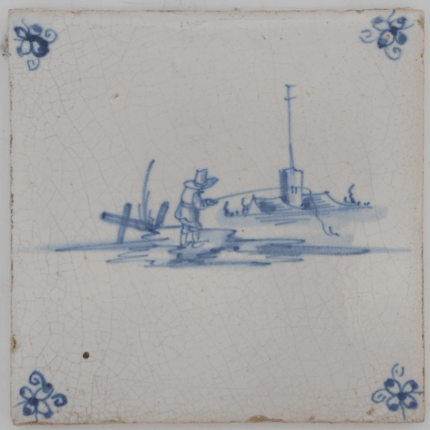
Dutch Fisherman |+/- 1720 (3)
€ 85,00This Delft tile, dating back to the early 18th century, is part of a collection that was once part of an old house in Antwerp. It illustrates a Dutch fisherman with a village noticeable in the distance. What makes this tile stand out is the level of detail in its design. Compared to earlier models, the brush lines are finer, and the details are much more intricate.
The corners feature the small “spider” motifs. The tiles have been painted as a set over 300 years ago, and you can see how well they fit together in both colour and design.
These tiles would work beautifully in a modern interior design project or as a unique framed piece of wall art. In the gallery, you can see how the tiles look when assembled, showcasing their harmonious design and the skill of their craftsmanship.
If you would like to purchase the other 3 tiles too, here are the website links:
https://blauweroos-antiek.nl/product/dutch-house-1700-6

Dutch Fisherman |+/- 1720 (2)
€ 85,00This Delft tile, dating back to the early 18th century, is part of a collection that was once part of an old house in Antwerp. It illustrates a Dutch fisherman with a village noticeable in the distance. What makes this tile stand out is the level of detail in its design. Compared to earlier models, the brush lines are finer, and the details are much more intricate.
The corners feature the small “spider” motifs. The tiles have been painted as a set over 300 years ago, and you can see how well they fit together in both colour and design. These tiles would work beautifully in a modern interior design project or as a unique framed piece of wall art.
In the gallery, you can see how the tiles look when assembled, showcasing their harmonious design and the skill of their craftsmanship. We offer single and double framing options for tiles; see image 6 for an example. Contact us on Instagram or Email for more information.
If you would like to purchase the other 3 tiles too, here are the website links:
https://blauweroos-antiek.nl/product/dutch-windmill-1700

Kid in a sleetje – Royal Delft – 1983
€ 90,00This charming Royal Delft tile, made in 1983, depicts a playful winter scene of a child sliding down a traditional Dutch sleetje (sled). Hand-painted in cobalt blue on a white tin-glazed surface, it showcases the timeless craftsmanship of Royal Delft. While the Delft factory continues to produce hand-painted tiles, this particular design has been discontinued.
The piece is in perfect condition and comes complete with its frame.

Frisian Flower | +/- 1770
€ 80,00This antique late-18th-century Delft blue tile features a traditional Frisian flower motif, admired for its finely detailed and elegant design. Unlike many Delft tiles of the period, it is notable for the absence of corner motifs.
The tile is in good condition for its age, with signs of wear.
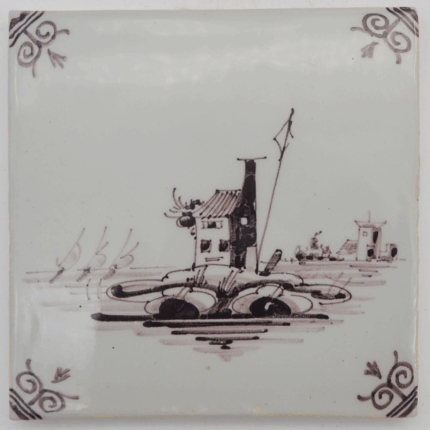
Dutch House – Makkum – 1976
€ 50,00A rare and finely hand-painted Makkum tile, made in 1976, depicting a typical Dutch farmhouse beside a calm body of water filled with boats in the distance. The scene is rich in detail and tradition, framed by classic ox-head corner motifs.
This tile is painted in a distinctive purple tone, achieved using manganese oxide—which was introduced in the 18th century as an alternative to the more common cobalt oxide blue. Manganese was used to create warmer, more subdued hues, adding a unique character to the piece.
The tile is in excellent condition, showing only minimal signs of age.
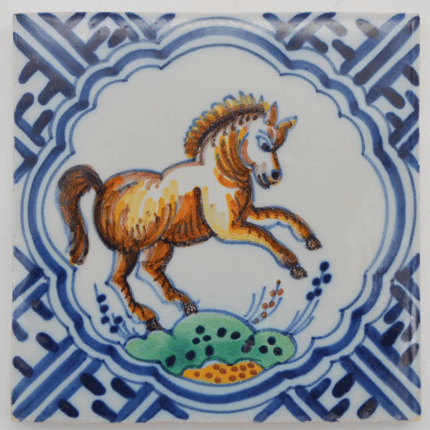
Horse – Makkum – 1977
€ 85,00A very rare and truly stunning Makkum tile, made in 1977, featuring a dynamic depiction of a horse painted in the traditional 17th-century Delft style. The horse, set within a soft, cloud-like circular border, stands on a beautifully rendered grassy field. With its alert posture and intense expression, the figure captures a moment of energy, as if the horse is about to leap.
The tile is framed by classic Wan-Li corner motifs, adding depth and historical character to the piece. Entirely hand-painted, the craftsmanship is exceptional.
The tile is in excellent condition, with only minor chips on the edges.

Dog – Makkum – 1972
€ 75,00A stunning and rare Makkum tile, made in 1972, featuring an alarmed dog painted in the traditional 17th-century Delft style. The central image is set within an orange diamond-shaped border, with the dog standing on a grassy field. In each corner, delicate motifs—executed in the classic reserve technique (uitgespaarde hoek)—highlight the tile’s detailed, hand-painted craftsmanship.
The tile is in excellent condition after more than 50 years, with only some minor chips on the edges.
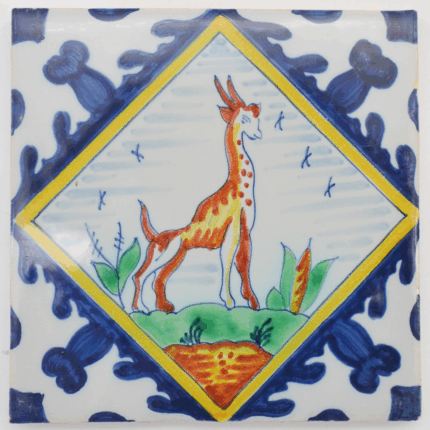
Giraffe – Makkum – 1999
€ 85,00A beautiful and very rare Makkum tile, made in 1999, featuring an elegant giraffe painted in the traditional Delft style of the 17th century. The central image is framed by an orange diamond-shaped border, with the giraffe standing on a grassy field. Delicate corner motifs, executed using the traditional ‘reserve technique’ shape (uitgespaarde hoek), complete the design and reflect the tile’s careful hand-painted craftsmanship.
The condition of the tile is excellent, with just a minor chip on the right border.

Flower Pot | +/- 1650
€ 125,00This 17th-century blue and white Delft tile features a central image of a stylised flower pot, framed within a diamond outline. Each corner is decorated with a fleur-de-lis (French lily) motif, a common ornamental element in Dutch tilework of the period.
Dating to around 1650, the tile is made of tin-glazed earthenware. It shows signs of age, including chipped edges and surface cracking, and has undergone some refurbishment. These features are typical for ceramics of this age and speak to its long history of use and preservation —, beautiful example of everyday decorative art from the Dutch Golden Age.

Pastoral scene | +/- 1750
€ 100,00This beautiful Delft tile, dating to around 1750, features a pastoral scene in which a female shepherd is approaching a man. In the background, sheep are visible, adding to the rural atmosphere, and a beautiful tree, delicately painted, fills the left corner.
Framed by traditional ox-head corner motifs, the tile reflects the decorative style of its time. It is in very good overall condition, with only minor signs of age.
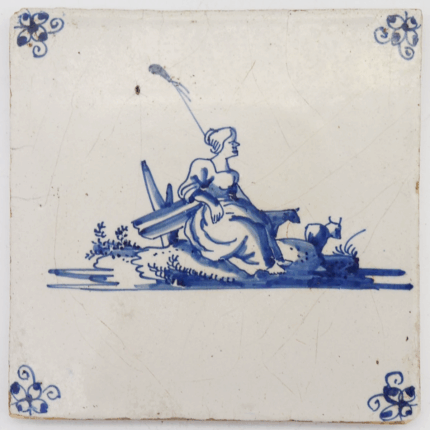
Female Shepard | +\- 1720
€ 125,00This charming Delft tile, made around 1720, depicts a peaceful pastoral scene featuring a seated female shepherd. She rests on a bench while sheep gather around her in the background, capturing a quiet moment of rural life.
The tile is framed with classic ox-head corner motifs, a common decorative element of the period. It remains in very good condition overall, with only minor edge chips consistent with its age.

Three tulips | +/- 1680
€ 150,00This Delft tile features a tulip, one of the most recognisable symbols of the Netherlands. It dates to shortly after the period known as tulip mania—an early example of a speculative financial bubble in European history.
The piece is in good overall condition, where damage is consistent with age.

Dutch landscape – Makkum – 1970s
€ 50,00A beautifully hand-painted Makkum tile, made in the 1970s, featuring a serene Dutch landscape. In the distance, a traditional farmhouse and several boats can be seen, set against an open sky and calm water—capturing the quiet charm of the Dutch countryside.
Executed in deep cobalt blue, the scene reflects the long-standing Delft tradition of using cobalt oxide to achieve its vibrant and enduring hue. The composition is framed by classic ox-head corner motifs.
The tile is in excellent condition, with only minor signs of age appropriate for its time.

Dutch Castle – Makkum – 1970s
€ 50,00This beautifully crafted Makkum tile features a detailed depiction of a Dutch castle house, rendered in classic Delft blue and white. The tile is meticulously hand-painted on a white tin-glazed surface, offering a smooth, glossy finish.
Produced by the Royal Tichelaar factory in Makkum, this piece reflects a ceramic legacy that dates back to 1572. Renowned for its dedication to traditional craftsmanship, Tichelaar played a pivotal role in building and preserving the rich ceramic heritage of Friesland.
With tile production ceasing in 2013, this tile is a rare and authentic collectable that embodies the artistry and history of Dutch ceramics.
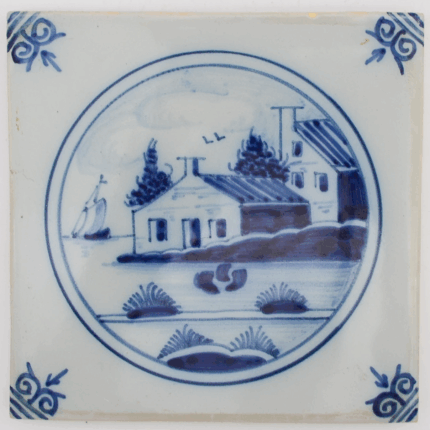
Farm House – Makkum – 1980s
€ 50,00A beautifully crafted Makkum tile featuring a detailed Dutch farm house in classic Delft blue and white. The design is hand-painted on a white tin-glazed surface, with a smooth, glossy finish.
This tile was produced by Tichelaar pottery in Makkum, a family-run factory with a history dating back to 1572. Renowned for its exceptional craftsmanship and dedication to traditional techniques, Tichelaar preserved the rich ceramic heritage of Friesland for centuries. As the factory ceased tile production in 2013, this piece stands out as a rare collectable.
The condition is perfect.
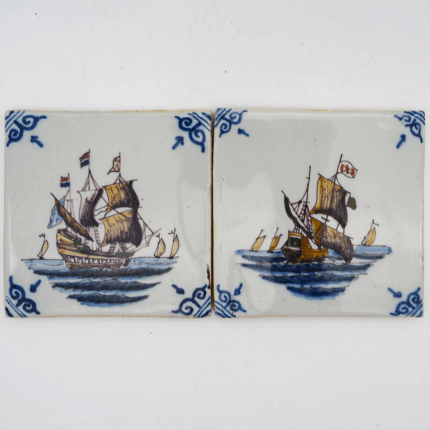
Dutch Ships – Makkum – 1960s
€ 60,00This beautifully crafted pair of Makkum tiles features intricate depictions of traditional Dutch trading ships, rendered in classic Delft blue and accented with vivid colours. The designs are meticulously hand-painted on a white tin-glazed surface, resulting in rich colours and a smooth, glossy finish.
Produced by the historic Tichelaar pottery in Makkum during the 1960s, these tiles are a testament to a ceramic legacy dating back to 1572. Renowned for its exceptional craftsmanship, Tichelaar preserved the rich ceramic traditions of Friesland through dedication to time-honored techniques.

Jumping Dog | +/- 1670
€ 250,00This Delft tile, crafted around 1670, portrays a delicate depiction of a jumping dog. The scene is framed by an accolade-shaped border and complemented by ‘winged-leaf’ corner motifs. The background features a detailed landscape adorned with flowers and dotted terrain, showcasing a rare and distinctive tile style typical of the mid-17th century.
The tile is in overall good condition, with minor wear visible on the bottom-left corner.
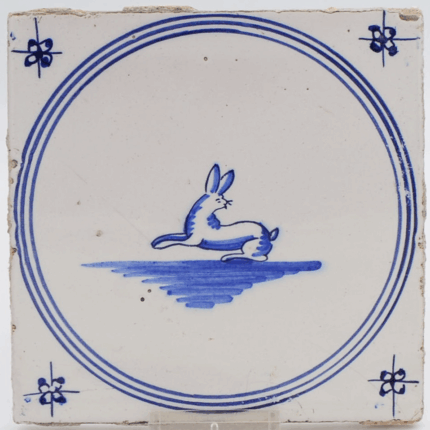
Hare | +/- 1780
€ 65,00This Delft tile, dating to around 1780, features a hare in motion, characteristic of the iconic ‘springer’ type. Hares are a traditional Dutch motif, often depicted in this style, reflecting their long-standing presence in the country’s fauna.
The design is enclosed within a circle, with the corners adorned by the classic ‘spider’ motif. The tile is in excellent condition for its age, with only minor wear visible on the top-right corner.
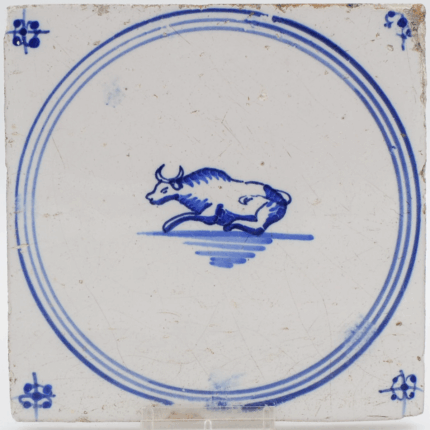
Bull | +/- 1780
€ 90,00This Delft tile, dating to around 1780, depicts a resting bull, which is a rare illustration for this type of tiles.
The design is framed within a circle, with the corners featuring the classic ‘spider’ motif. While the tile remains in good condition for its age, there is some damage along the bottom rim and the top-right corner.

Flower Pot | +/- 1680
€ 250,00An elegantly crafted Delft tile from circa 1680, featuring a beautifully adorned flower pot. At its centre is a tulip, flanked by two side flowers that subtly echo the popular ‘spider’ corner motif, adding to its rarity and charm. The tile is further embellished with the distinctive ‘ox-head’ motif.
A unique piece that is found in overall good condition, with a small damage on the left bottom corner and some rim chips.

Biblical Scene – Makkum – 1970s
€ 90,00This detailed Makkum tile from 1976 portrays a biblical scene from the village of Nain, where Jesus encounters a funeral procession for a widow’s only son. The tile captures the moment Jesus, moved by compassion, raises the young man from the dead. This depiction reflects a story of profound hope and restoration, highlighting themes of empathy and divine intervention.
The tile is in perfect condition after 49 years.

Playful Dog | +/- 1620
€ 325,00This antique Delft tile, dating to circa 1620, offers a delightful depiction of a cheerful dog standing on a grassy patch, framed within a diamond square, or “kwadraat” in Dutch. The scene is set against a vibrant blue sky populated with birds, adding depth and liveliness to the design. The corners feature reserve-painted, stylised wheel-like ornaments, further enriching its decorative appeal. Its notable thickness reflects its origins in the early decades of the Dutch tile industry.
Despite minor corner damages consistent with its age, the tile’s central motif remains remarkably vivid and captivating, showcasing the enduring quality of early Delft craftsmanship.
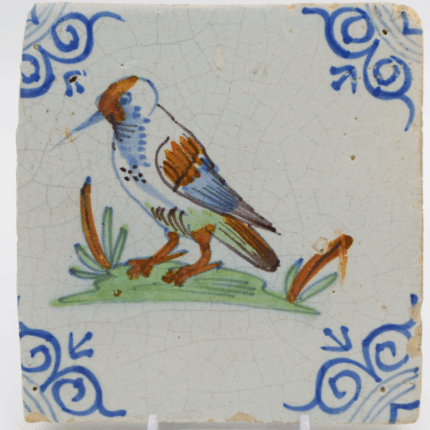
Bird | +/- 1650
€ 160,00This early 17th-century Delft tile showcases a cheerful bird standing amidst a vividly colourful grass field, rendered in bright shades of orange, green, and blue. The corners are embellished with the prominent ox-head motif, a defining feature of Delftware from this era.
While the tile retains much of its charm and historical appeal, its condition is marked by cracks along the corners and a minor sanding down on the left side, reflecting its age and use.

Bird | +/- 1650
€ 300,00This 17th-century Delft tile depicts a delightful bird standing on a branch, surrounded by a grass field, in vibrant shades of orange, green, and blue. Each corner features the big ox-head motif, one of the most recognisable corner designs in Delftware, which was widely used during the mid 1600s.
The condition is excellent with very small signs of wear on the glaze surface.

Traditional Houses – Makkum – 1980s
€ 150,00A beautifully crafted pair of Makkum tiles featuring detailed depictions of traditional Dutch houses in classic Delft blue and white. The designs are hand-painted on a white tin-glazed surface, resulting in vivid colours and a smooth, glossy finish.
These tiles were produced by Tichelaar pottery in Makkum during the 1980s. With a history dating back to 1572, Tichelaar was renowned for its exceptional craftsmanship and dedication to traditional techniques, preserving the rich ceramic heritage of Friesland. As tile production ceased in 2013, this pair offers a charming and authentic glimpse into Dutch artistry and culture.

Dutch Port – Makkum – 1990s
€ 90,00A beautifully crafted Makkum tile featuring a detailed Dutch port scene in classic Delft blue and white, complemented by brown-toned colouring. The design is hand-painted on a white tin-glazed surface, resulting in vivid colours and a smooth, glossy finish.
This tile was produced by Tichelaar pottery in Makkum, a family-run factory with a history dating back to 1572. Renowned for its exceptional craftsmanship and dedication to traditional techniques, Tichelaar preserved the rich ceramic heritage of Friesland for centuries. As the factory ceased tile production in 2013, this piece stands out as a rare collectable.

Houses & Windmills – Makkum – 1970s
€ 180,00A beautiful set of four small makkum tiles in Delft blue and white style. Traditional Makkum tiles are known for its vivid hand-painted designs and glossy finish. The process involves painting directly on a white tin-glazed surface, resulting in vibrant colours and a smooth, reflective glaze.
Produced by the renowned Tichelaar pottery in Makkum, a family-owned factory with roots dating back to 1572, this tile reflects centuries of Dutch ceramic heritage. Tichelaar Makkum gained fame for its exceptional craftsmanship and traditional methods, preserving the artistry of Friesland for generations. While the factory stopped producing tiles in 2013, their creations remain sought after as rare collectables.

Standard-bearer | +/- 1680
€ 400,00This antique Delft tile features a depiction of a 17th-century standard-bearer (vaandrig), a figure of great significance in the Dutch army of the time. The standard-bearer was entrusted with the vital task of carrying the company’s flag—a symbol of honour, unity, and identity—making them a central figure on the battlefield.
This role, while prestigious, came with immense risk, as their exposed position often made them a target. Carrying the standard required both hands, leaving them without firearms; however, they were typically equipped with a small sword or rapier for self-defence.
Hand-painted in traditional cobalt blue on white tin glaze with the classic ‘ox head’ motif, this tile beautifully captures the historical essence and artistic finesse of Delftware. It serves as a tribute to the bravery and symbolism embodied by the standard-bearer.
In good condition for its age, with small signs of wear, this tile is a remarkable piece of history and a valuable addition to any collection of antique ceramics or military-themed art.

Merman Cupid | +/- 1660
€ 500,00This rare and enchanting antique Delft tile features a unique depiction of a half-merman, half-angel Cupid poised with his bow and arrow. Blending mythological and ethereal elements, this striking motif symbolises love’s transformative and transcendent power, making it a true conversation piece.
Hand-painted in classic cobalt blue on a white tin-glazed surface, the craftsmanship reflects the finest traditions of 17th-century Dutch Delftware. The design captures the artistry and creativity of its era. Originally crafted as a functional and decorative piece for Dutch homes, this tile now stands as a rare and collectable artefact.
Despite its age, the tile remains in good overall condition, with light wear and refurbishing work consistent with its history. This one-of-a-kind piece is perfect for collectors, art enthusiasts, or anyone seeking a distinctive addition to their home or collection of historical ceramics.

Child Without a Flag | +/- 1650
€ 450,00This antique Delft tile features the charming and iconic ‘Kind zonder Vlag’ (Child Without a Flag) motif, a beloved design from 17th-century Dutch tile-making traditions. The hand-painted cobalt blue illustration depicts a child holding his hand up, pretending holding a flag, symbolising innocence and simplicity, while reflecting the playful spirit of childhood.
Framed by elegant ‘ox-head’ corner motifs, this tile embodies the timeless artistry of Delftware, with its classic blue-and-white palette and attention to detail. Originally used as a decorative and functional element in Dutch homes, this piece has endured as a symbol of cultural heritage and craftsmanship.
In good condition for its age, with minor wear that enhances its antique charm, this tile is a rare find and a perfect addition to any collection of historic ceramics or Delftware art.

Cupid | +/- 1700
€ 175,00This antique Delft tile features a striking and thought-provoking depiction of Cupid appearing to be struck by an arrow, evoking themes of love, vulnerability, and romantic longing. Crafted around the year 1700, this tile showcases the timeless artistry of Delftware, with its intricate design rendered in classic cobalt blue on a white glaze. The piece is further adorned with elegant ‘spider’ corner motifs.
Despite its age, the tile remains in good condition, with minor wear that only enhances its antique charm—a rare and meaningful addition to any collection.

Dog | +/- 1640
€ 250,00This tile dates back to approximately 1640 and is quite rare due to its unique design. It features a blue ‘ox-head’ corner motif paired with a polychrome central scene depicting a large dog. The large size of the ‘ox-head’ motif and the thickness of the tile are indicators of its remarkable age.
The tile is in overall good condition, with a small chip on the top side and slight baking imperfections on the left side corner motifs. Restoration work can also be seen on a line in the middle of the title.

Bird | +/- 1630
€ 325,00This early 17th-century tile depicts a delightful bird perched on a fruit-laden branch, likely bearing cherries, in vibrant shades of orange, green, and blue.
The scene is framed by a double-lined medallion, a design typical of this era. Each corner features the ox-head motif, one of the most recognizable corner designs in Delft tiles.
The condition is very good with small chips on the sides and corners.

Three Tulips | +/- 1650
€ 250,00This tile, dating from around 1650, features a vibrant and detailed depiction of three tulips.
The design showcases the tulips emerging from a single bulb, with evenly spaced leafs on either side. It was created near the end of the ‘Tulip Mania’ period, when rare tulip bulbs were subject of speculation and said to be worth as much as a canal house in Amsterdam. It incorporates the ‘three-dot’ corner motif, which is derived from the symbol of the Trinity.
The tile is in excellent condition, with only small chips on the lower corners.

Pomegranates and grapes | +/- 1640
€ 175,00This early Delft tile dates back to around 1640, making it almost 400 years old. It features an intricately painted and beautifully detailed design of pomegranates and grapes, with a central rosette.
Pomegranates & Grapes:
In 17th-century Holland, pomegranates and grapes were rich in symbolism. The pomegranate symbolized eternal life and resurrection in Christian art, as well as fertility, abundance, and prosperity. It also had ties to classical mythology, representing the cycle of life, death, and rebirth, while its exotic nature reflected the wealth of Dutch trade. Grapes, on the other hand, were associated with the Eucharist and the blood of Christ, symbolizing wealth, abundance, and the rewards of labor. They also represented the fleeting nature of life in still-life art and symbolized the prosperity brought by global trade.
The condition of the glaze and colouring is very good. The tile has some chips on the corners.

Farmer | +/- 1680
€ 95,00Interesting tile showing a farmer with a rake. Or perhaps a fisherman with a harpoon?
Antique tiles were made from stories, and in turn led to new storytelling. Often, the most interesting tiles are those that are ambiguous. This one is a great example.
With ‘spider’ corner motives. The condition is very good for such an old tile, with a few minor spots visible.

Landscape | +/- 1780
€ 75,00This tile shows a house and a church surrounded by fields and boats. For the average 18th century Dutchman this scene represented the pinnacle of earthly success. The tile is painted with manganese pigment.

Dutch House | +/- 1750
€ 85,00This tile shows a house with a smoking chimney, amidst fields and water.