
Showing all 36 resultsSorted by latest

Round Vase, Mobach, Utrecht
€ 150,00Klaas Jan Mobach founded Mobach Keramiek in 1895, establishing a family-run ceramic workshop in Utrecht, Netherlands, that still exists today. Originally known as the Utrechtse Pottenfabriek, Mobach Keramiek has become renowned for its handcrafted vases and pots, distinguished by their innovative designs, exceptional quality, and blend of traditional techniques with modern influences.
Ceramic vase no. 695 is a notable example of Mobach Keramiek’s craftsmanship. Designed by Klaas Jan Mobach in the 1920s, this piece embodies the geometric shapes, bold lines, and contrasting colours that define the Art Deco style of the era. The vase is entirely hand-thrown and hand-finished.
The vase bears the model number 695 and has “Mobach Utrecht” engraved on its base, confirming its authenticity and origin. The piece is in very good condition.

Vase, decor ‘Rhodian’, Zuid-Holland, Gouda
€ 150,00Beautiful dark green matte-glazed Art Deco vase made by Plateelbakkerij Zuid-Holland (PZH), the most influential pottery factory in Gouda between 1898 and 1965. PZH became internationally known for its innovative glazes and richly decorated plateel, producing more decorative ceramics than any other local workshop.
This piece reflects the factory’s shift from Art Nouveau to early Art Deco, with its deep matte colour and simplified, modern forms. The Rhodian decor was one of the first designs released in the first decade of the century and drew from Middle Eastern and Ottoman ceramic traditions. Typical features include stylised scrolls, floral motifs, and rhythmic repeating patterns—elements that made PZH’s work world-famous.
The marks on the base identify the factory, the artist, and the production year, confirming the jug’s authenticity. There is a noticeable chip on the rim.

Vase, decor ‘Max’, Zuid-Holland, Gouda
€ 120,00This beautiful green Art Deco vase was produced in 1919 by Plateelbakkerij Zuid-Holland (PZH), a renowned pottery factory based in Gouda, the Netherlands. The piece features the “Max” design, a hand-painted decorative motif characterised by flowers, stylised scrolls, and rhythmical patterns in vibrant colours, including ochre yellow, olive green, red, and blue.
Plateelbakkerij Zuid-Holland, active from 1898 to 1965, became well known for its high-quality decorative ceramics and distinctive artistic style. The “Max” decor reflects the early post-war aesthetic, combining traditional craftsmanship with stylistic influences from the factory’s earlier celebrated designs, such as the ‘Rhodian’ series. The use of curved, flowing lines and repeated ornamental motifs is typical for this period.
The condition of the vase is excellent, with normal signs of wear for its age

Flower Plate, decor ‘Juliette’, Zuid-Holland, Gouda
€ 85,00This small plate, produced in 1942 by the Zuid-Holland factory in Gouda, decor ‘Juliette’, reflects the refined artistry of one of the leading makers of matte-glazed ceramics in the early 20th century. The design features a matte decoration of leaves combined with a glossy finish for the background and flower petals in rich orange-beige tones accented with dark green and yellow. The leaves were painted over the glaze, creating a subtle raised texture that brings the motif to life when touched.
The plate has survived in excellent condition.

Leaf Plate, decor ‘Bladeren’, Zuid-Holland, Gouda
€ 300,00This absolutely stunning deep plate, produced in 1924 by the Zuid-Holland factory in Gouda, decor ‘bladeren’, reflects the refined artistry of one of the leading makers of matte-glazed ceramics in the early 20th century. The design features a matte decoration of grapes and leaves in rich brown tones accented with electric blue. The leaves were painted over the glaze, creating a subtle raised texture that brings the motif to life when touched.
From 1908 onward, N.V. Koninklijke Plateelbakkerij Zuid-Holland developed its distinctive matte glaze known as matt plateel. Presented at the Leipzig Fair in 1910 and the San Francisco World’s Fair in 1915, these designs were inspired by ancient Greek and Persian ornament and often given evocative names such as Rhodian, Damascus, Salak, and Purdah. Matt Plateel represented a shift away from the flowing lines of Art Nouveau, mirroring the changing artistic sensibilities of the early 20th century.
This example has survived in excellent condition—remarkably well-preserved after more than a century.

Spiral Vase, decor ‘Japara’, Regina, Gouda
€ 250,00This striking Plateel spiral vase, produced by the Regina factory in the 1920s, is an exceptional example of early 20th-century Dutch ceramic design. The piece features a gently twisting form decorated with hand-painted motifs in rich tones of dark and light brown, complemented by white, orange, and blue. The balanced interplay of colour and pattern is characteristic of Regina’s expressive Art Deco style.
The vase reflects the factory’s distinctive craftsmanship and artistic ambition, which placed Regina among the leading Dutch potteries of its time. It remains in excellent condition, with only minor glaze irregularities consistent with age.

Pot with Lid, decor ‘Marga’, Zuid-Holland, Gouda
€ 200,00This small pot, made in 1923 by Plateelbakkerij Zuid-Holland in Gouda, is decorated with a matte glaze in turquoise, green, and orange-yellow. The piece is characteristic of early Dutch Art Deco ceramics, with its simple form and restrained but vivid colour palette.
Plateelbakkerij Zuid-Holland was the largest pottery in Gouda at the time and is especially associated with stylised floral designs produced between 1900 and 1924. This example is marked on the base with both the factory stamp and the painter’s signature.
It has survived in excellent condition after more than a century.
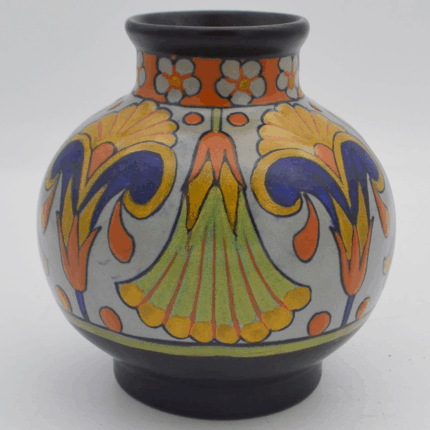
Vase, decor ‘Lotus’, Zuid-Holland, Gouda
€ 80,00This delicate vase was made in 1924 by Plateelbakkerij Zuid-Holland, a well-known pottery factory based in Gouda, the Netherlands. The design is named “Lotus”, a hand-painted decorative pattern featuring stylised floral and abstract elements in bold colours such as ochre yellow, olive green, teal, purple, and deep blue.
Zuid-Holland, sometimes referred to as PZH, was active from 1898 until 1965 and gained a reputation for producing high-quality decorative ceramics. The “Lotus” design is typical of the interbellum period, combining traditional craftsmanship with mid-1920s stylistic elements.
The condition is very good with a small chip visible on the top rim.

Vase, decor ‘Lotus’, Regina, Gouda
€ 125,00Leaf-inspired small-sized vase with powerful nuances of blue, yellow and brown, in Art Deco Matte style, model “lotus”. The piece was made between 1927 and 1935, according to the markings on the bottom. Regina factory was formed in 1898 and named after Queen Wilhelmina. Their creations rose to the standard of perfection and were the true premiums of those days. Both the original factory signature and style are visible on the bottom.
The piece is in excellent condition.

Round Jug, Mobach, Utrecht
€ 150,00This beautifully round abstract-shaped jug, model no. 482 was crafted by Mobach Keramiek in Utrecht during the second quarter of the 20th century. It is marked on the base with “Mobach, Utrecht” and the model number, confirming its origin and authenticity.
Founded in 1895 by Klaas Jan Mobach, Mobach Keramiek began as the ‘Utrechtse Pottenfabriek’ and grew into a respected name in Dutch ceramic art, which is still in operation today. The family-run workshop became known for its distinctive vases and vessels, blending traditional craftsmanship with evolving modern styles.
Model 482 is a fine example of the Art Deco influences that shaped Mobach’s work in the 1930s. Characterised by clean geometric lines and restrained form, this piece reflects both the artistic sensibilities of the era and the meticulous hand-finishing typical of Mobach creations.
Made from high-quality earthenware and finished in a dark beige-grey glaze, the jug remains in perfect vintage condition.

Cigarette pot, decor ‘Tagora’, Regina, Gouda
€ 95,00This colourful, leaf-inspired Plateel pot, made by the renowned Regina factory in the 1920s, is a fine example of early 20th-century Dutch ceramic craftsmanship. Like many plateel factories of the time, Regina began with pipe production and gradually shifted toward ceramics—often continuing to include tobacco-related items in their collections. The pot was meant to be a cigarette holder.
The pot’s graceful shape and rich glaze reflect the distinctive style and skill of Regina’s artisans, who played an important role in shaping the Dutch ceramics landscape of the period. The piece remains in very good condition, with minor glaze irregularities typical for its age.

Large Vase, Ivora, Gouda
€ 150,00A large, beautifully decorated vase in deep colours and high-glaze, this piece represents a perfect example of Ivora’s ceramic artistry. Positioned stylistically between Art Nouveau and Art Deco, it embodies the transitional elegance of early 20th-century Dutch design.
Ivora was the second-largest plateel factory in the Netherlands after PZH. Originally a pipe manufacturer, the factory began producing decorative ceramics in 1915, thanks to the expertise of four skilled decorators who had previously worked at the prestigious Rozenburg factory.
Among Ivora’s most distinctive creations were the high-glaze “BO” series, produced between 1919 and 1928. These designs featured stylised wildflowers set against rich, dark green backgrounds. This vase is a fine example from that series, showcasing the factory’s technical skill and decorative flair during its most influential period.

Flower Plate, decor ‘Rigi Royal’, Zuid-Holland, Gouda
€ 180,00This ceramic plate was produced in the 1950s by Plateelbakkerij Zuid-Holland, a renowned pottery factory located in Gouda, the Netherlands. The design is named “Rigi Royal”, a hand-painted decorative pattern featuring stylised floral and abstract elements in bold colours such as ochre yellow, olive green, teal, purple, and deep red.
Zuid-Holland, sometimes referred to as PZH, was active from 1898 until 1965 and gained a reputation for producing high-quality decorative ceramics. The factory was granted the right to use the title “Royal” in 1930, and its later work—including pieces like this—continued the tradition of richly colored, ornamental design that had become associated with Gouda pottery.
The “Rigi Royal” design is typical of the post-war period, combining traditional craftsmanship with mid-century stylistic elements. It reflects the continuing influence of earlier Art Nouveau and Art Deco movements, interpreted in a more modern, expressive form.

Small Pot, decor ‘Panan’, Regina, Gouda
€ 70,00This stunning plateel pot, crafted by the renowned Regina factory in the 1920s, is a remarkable example of early 20th-century Dutch ceramic artistry. It features a graceful three-legged base and beautifully hand-painted designs, showcasing the vibrant colours and intricate patterns that define the Plateel style.
The pot’s elegant form and bold glaze embody the exceptional craftsmanship and creative vision of the Regina factory, a key player in Dutch ceramics during this period.
The piece is in very good condition with the expected glaze imperfections due to its age.
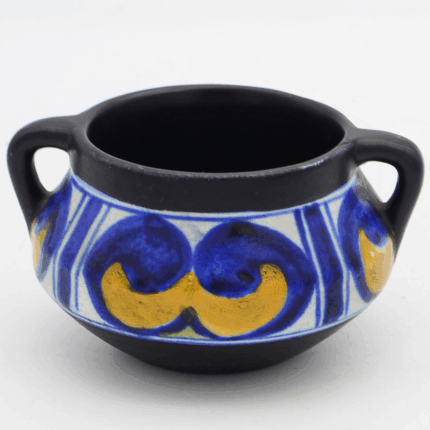
Small Pot, decor ‘Simpie’, Zuid-Holland, Gouda
€ 50,00This beautiful small pot, created in 1922, showcases a blue and black electric matte glaze pattern in a beautiful example of Art Deco ceramics. With its original form and elegance intact, it highlights the enduring craftsmanship of Plateelbakkerij Zuid-Holland. As Gouda’s largest pottery, Zuid-Holland dominated the market with its decorative pieces, particularly known for its darker, stylised floral patterns produced between 1900 and 1924.
This piece features factory marks and the artist’s signature on the base. Remarkably, the vase remains in perfect condition after over a century.

Small Vase, decor ‘Teheran’, Regina, Gouda
€ 120,00Floral-inspired small-sized vase with powerful nuances of blue, in Art Deco Matte style, model “teheran”. The piece was made in the years between 1927 and 1935, according to the markings on the bottom. Regina factory was formed in 1898 and named after Queen Wilhelmina. Their creations rose to the standard of perfection and were the true premiums of those days. Both the original factory signature and style are visible on the bottom.
The condition is excellent.

Lidded Sunflower Vase, De Distel, Amsterdam
€ 650,00This stunning lidded vase from De Distel, Amsterdam, was produced around 1900. Founded in 1895, the factory quickly gained immense international recognition through its participation in numerous exhibitions across Europe. Produced during the highlight of Dutch Art Nouveau, this vase exemplifies the exceptional quality and artistic vision that defined De Distel.
Much like the esteemed Rozenburg factory, De Distel produced high-glazed ceramics featuring flower and bird-inspired motifs between 1895 and 1911. This particular piece showcases a vibrant palette of yellow, red, and blue on a rich brown background, with a striking large flower as the central design element.
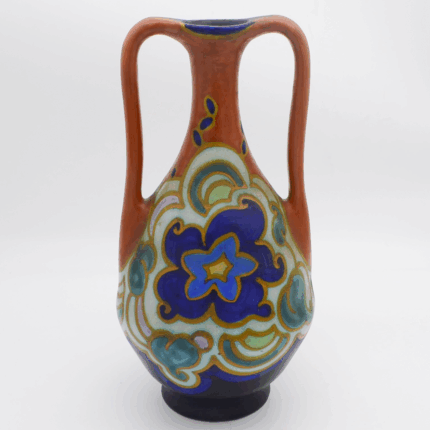
Jug with handles, decor ‘Flora’, Zenith, Gouda
€ 200,00A distinctive jug featuring pastel hues with warm orange accents, designed in a matte Art Deco style. Produced by Zenith, a renowned pottery manufacturer that began as a pipe-making factory in 1749 before transitioning to creating Plateel art pieces in 1918. Zenith’s matte floral designs quickly became a hallmark of their artistry, offering strong competition to other Gouda-based factories.
This piece exemplifies the innovative craftsmanship and aesthetic appeal that defined Zenith’s contributions to decorative ceramics.
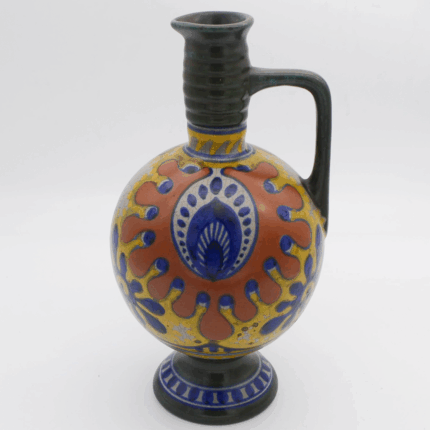
Jug, decor ‘Rhodian’, Zuid-Holland, Gouda
€ 175,00Beautiful example of a dark green colored Art Deco Matte jug, produced in 1922. The Middle Eastern inspired Rhodian decors were developed in the 1910s and went on to become a world-wide bestseller. Plateelbakkerij Zuid-Holland became the biggest pottery in Gouda and made more decorative pieces than any other Dutch producer.
The signature on the bottom showcases the artist, year and factory marks.

Plate, decor ‘Atol’, Zuid – Holland, Gouda
€ 225,00A ceramic plate featuring a rare design of black tulips in an Art Nouveau style. The intricate patterns and matte finish reflect the early 20th-century transition into Art Deco. The combination of vibrant colours and soft pastel tones adds depth to the piece.
The plate includes markings on the underside, showing the artist’s initials (Baukje Kwinkelenberg), the Zuid-Holland factory mark, the production year, and the decor name.

Large Vase, Zuid-Holland, Gouda
€ 950,00Exceptionally beautiful, large and rare vase in the Dutch Art Nouveau style, featuring a 360-degree peacock design. Made by Plateelbakkerij Zuid-Holland, the largest pottery in Gouda at the time, this vase represents the colourful matte-glaze decor typical of their work between 1900 and 1924.
The carved year mark on the base dates this piece to 1900, during the factory’s early period of decorative experimentation, when the year marks were still carved instead of painted on the bottom.
There are minor signs of wear on the glaze layer, appropriate for its age.

Pedestal Bowl, Nieuw-Rozenburg, Den Haag
€ 175,00This beautiful, dark colored pedestal bowl was created by the Nieuw-Rozenburg factory in The Hague.
Nieuw-Rozenburg only existed for a few years. It was established in 1919 by Rudolf Sterken, a former employee of the famous Rozenburg factory (1883-1917), that gained international acclaim for its exceptional ceramics, particularly during the Art Nouveau period.
Despite of the excellent quality of the Nieuw-Rozenburg designs, the factory was commercially unsuccesful. It had to close its doors in 1923.
This rare bowl is in excellent condition, with a very small chip on the rim.

Vase Set, decor ‘Mat Vogels’, Zuid-Holland, Gouda
€ 800,00This set, designed by Willem Hartgring and painted by Karel van de Heuvel, is a remarkable example of Dutch Art Nouveau ceramics and a testament to the craftsmanship and artistry that defined PZH’s plateel production. Sets like this are rare.
After leaving Rozenburg, Willem Hartgring brought his innovative techniques and designs to Plateelbakkerij Zuid-Holland (PZH), where he greatly influenced production between 1907 and 1920. Drawing from his experience at the renowned Rozenburg factory, Hartgring introduced the NP (New Porcelain) decors, which featured detailed floral motifs in bright colours on a white background. Initially finished with a thin, glossy transparent lead glaze, these pieces took on a distinctive matte appearance after the introduction of a perfected matte glaze in 1910.
The matte NP pieces, often referred to as Mat Vogels (MV) and Mat Bloemen (MB), showcased soft, chalky hues that quickly gained popularity. MV decors frequently included parrot motifs, which peaked in popularity around 1907 but continued to be produced into the 1920s.
The condition is excellent aside from one very thin scratch on one of the vases’ neck interiors.
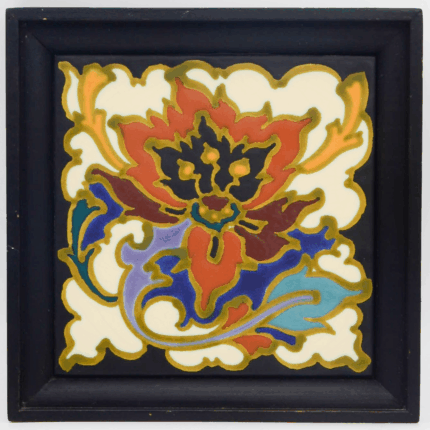
Flower tile, decor ‘Rosario’, Regina, Gouda
€ 95,00This beautiful tile, crafted by the renowned Regina factory in the 1920s, is an example of early 20th-century Dutch ceramic artistry. Featuring intricate hand-painted designs, it showcases the bold colours and detailed patterns characteristic of the Plateel style.
The tile’s vibrant matte glaze and meticulous craftsmanship reflect the creative vision of the Regina factory, a significant name in Dutch ceramics during the early 20th century. A fine piece that comes with its original frame and factory marks on the bottom. The condition is excellent, with only a few scratches on the wooden frame.

Small Wall Plate, decor ‘Danier’, Zuid-Holland, Gouda
€ 100,00This striking matte wall plate, crafted in 1924, features the Danier matte glaze pattern. A stunning example of blue-toned Art Deco ceramics, it retains its original form and elegance, showcasing the timeless appeal of Plateelbakkerij Zuid-Holland’s craftsmanship.
As the largest pottery in Gouda, Plateelbakkerij Zuid-Holland dominated the market with its decorative pieces, producing more than any other manufacturer. Their darker, stylised floral high-glaze patterns, a hallmark of their artistry, were crafted between 1900 and 1924.
This piece bears factory marks, the artist’s signature, and the year of production on its base. The plate is in perfect shape after more than 100 years since its production.

Jug with handle, Mobach, Utrecht
€ 140,00Klaas Jan Mobach founded Mobach Keramiek in 1895, establishing a family-run ceramic workshop in Utrecht, Netherlands. Originally known as the Utrechtse Pottenfabriek, Mobach Keramiek has become renowned for its handcrafted vases and pots, distinguished by their innovative designs, exceptional quality, and blend of traditional techniques with modern influences.
Ceramic vase no. 746 is a notable example of Mobach Keramiek’s craftsmanship. Designed by Klaas Jan Mobach in the 1930s, this piece embodies the geometric shapes, bold lines, and contrasting colours that define the Art Deco style of the era. The vase’s elegant design and meticulous hand-finishing reflect the artistic vision and attention to detail for which Mobach is celebrated.
Made from high-quality earthenware, the vase bears the number 746 and “Mobach Utrecht” engraved on its base, confirming its authenticity and origin. It is in good condition despite its age, with small chips on the rim.

Small Wall Plate, decor ‘Rhodian’, Zuid-Holland, Gouda
€ 100,00This striking matte wall plate, crafted in 1924, features the renowned Rhodian matte glaze patterns designed by Daniël Harkink and L.J. Müller around 1908.
Inspired by Middle Eastern designs, the Rhodian decors became an international sensation and a best-seller, solidifying the factory’s reputation. As the largest pottery in Gouda, Plateelbakkerij Zuid-Holland dominated the market with its decorative pieces, producing more than any other manufacturer. Their darker, stylised floral high-glaze patterns, a hallmark of their artistry, were crafted between 1900 and 1924.
This piece bears factory marks, the artist’s signature, and the year of production on its base. The plate is in perfect shape after more than 100 years since its production.
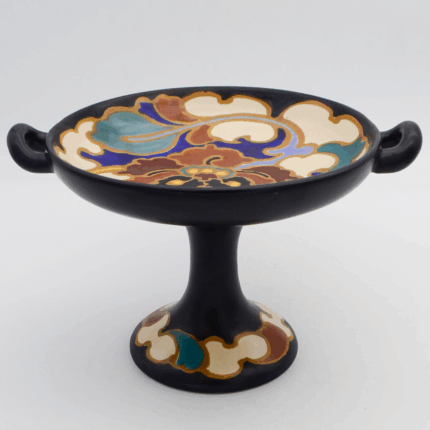
Pedestal Bowl With Handles, decor ‘Rosario’ , Regina, Gouda
€ 200,00This exquisite Plateel pedestal bowl, crafted by the renowned Regina factory in the 1920s, is a stunning example of early 20th-century Dutch ceramic artistry. Featuring a graceful pedestal base and beautifully hand-painted designs, it showcases the bold colours and intricate patterns characteristic of the Plateel style.
The bowl’s elegant form and vibrant glaze reflect the craftsmanship and creative vision of the Regina factory, a significant name in Dutch ceramics during the early 20th century. A fine piece that bridges functionality and artistic heritage.
The condition is perfect.
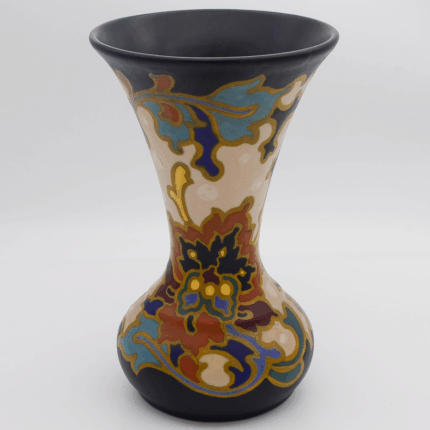
Vase, decor ‘Rosario’, Regina, Gouda
€ 250,00Floral-inspired medium-sized vase in Art Deco Matte style, model “Rosario”, the most famous design of Steef A. Boers. Regina factory was formed in 1898 and named after Queen Wilhelmina. Their creations rose to the standard of perfection and were the true premiums of those days. Both the original factory signature and style are visible on the bottom.
The piece is in perfect shape.

Long Vase, decor ‘Amata’, Royal Goedewaagen
€ 325,00This vase by the Royal Goedewaagen pottery was produced in 1987. It is a hand-painted, limited edition replica of the iconic Amata vase intially produced in the early 1920s. Its design is highly delicate, with exquisite Art Nouveau floral patterns.
The vase is signed at the bottom, with the decor name (Amata), the factory’s stamp, the production number 463/999 (999 vases were produced, of which this is number 463), and the painter’s signature.
The condition is perfect.

Flower pot, decor ‘Pensee’, Arnhemsche Fayencefabriek, Arnhem
€ 180,00This is a beautiful example of Art Nouveau pottery with Japanese flower inspiration.
The Arnhemsche Fayencefabriek was a well-known Dutch factory at the time when plateel boomed in Gouda. The factory gained appreciation through the works of the famous Willem Hartgring who came to work here after previous assignments at Rozenburg (The Hague) and Zuid-Holland (Gouda). Hartgring’s Japanese styled birds and flower motifs belong to the best work in this genre that has ever been created in the Netherlands.
The factory’s rooster mark, decor, model and painter marks can be found at the bottom of the vase.
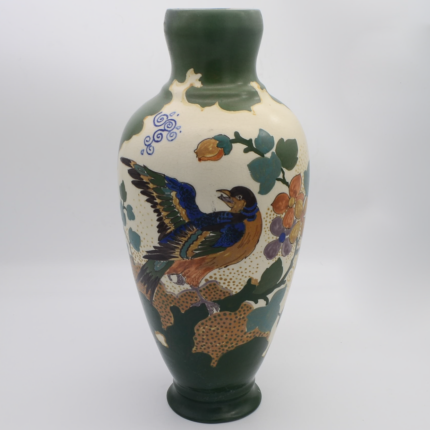
Large Vase, decor ‘Vogel’, Arnhemsche Fayencefabriek, Arnhem
€ 500,00Stunning, rare vase with a decor designed by W. Hartgring for Arnhemsche Fayencefabriek.
The Arnhemsche Fayencefabriek was a well-known Dutch factory at the time when plateel boomed in Gouda. The factory gained appreciation through the works of the famous Willem Hartgring who came to work here after previous assignments at Rozenburg (The Hague) and Zuid-Holland (Gouda). Hartgring’s Japanese styled birds and flower motifs belong to the best work in this genre that has ever been created in the Netherlands.
The factory’s rooster mark, decor, model and painter (JvN) marks can be found at the bottom of the vase.

Wall plate ‘Decor Breetvelt’, Plateelbakkerij Zuid-Holland, Gouda
€ 250,00Beautiful Art Deco wall plate, designed by Henri Breetvelt, and painted by Gerrit Pieter van den Akker.
Henri Breetvelt (1864-1923) was nicknamed by his peers ’the king of pottery painters’. His designs were pathbreaking and highly influential. His work is represented in various Dutch museums.
His designs continued to bee prodcued after his death under the name “Decor Breetvelt”.

Wall plate ‘Decor Breetvelt’, Plateelbakkerij Zuid-Holland, Gouda
€ 350,00Beautiful Art Deco wall plate, designed by Henri Breetvelt, and painted by M. Burger.
Henri Breetvelt (1864-1923) was nicknamed by his peers ‘the king of pottery painters’. His designs were pathbreaking and highly influential. His work is represented in various Dutch museums.
His designs continued to be produced after his death under the name “Decor Breetvelt”.

Pair of large Vases, decor ‘Rosario’, Regina, Gouda
€ 650,00Set of ‘Rosario’ vases.
The famous ‘Rosario’ decors was designed by Steef Broers in the late 1920s and has been produced by Regina for over 50 years. This early set can be dated around 1930. Unlike later production, this model is entirely hand-painted (with painter’s signature). Both vases are in pristine condition.

Large Lidded Vase, Plateelbakkerij Zuid-Holland, Gouda
€ 575,00Colorful large vase with lid, Flambé decor, in Art Nouveau style.
Plateelbakkerij Zuid-Holland went on to become the biggest pottery in Gouda and made more decorative pieces than any other. Their high-glaze decors, in darker stylised floral decors were produced from 1900 to 1924. According to the year mark, this model was made in 1918.
A very small chip can be seen at the bottom of the vase, however it does not affect the balance and it cannot be spotted.