
Showing all 142 resultsSorted by latest

Child blowing bubbles | +/- 1680
€ 175,00An antique Delft tile dating to approximately 1680, depicting the well-known scene of a young boy blowing soap bubbles. The decoration is painted in cobalt blue on a white tin-glazed ground and is framed by traditional ox-head corner motifs, characteristic of late 17th-century Delftware.
The condition of the tile is very good, with some minor glaze damage.
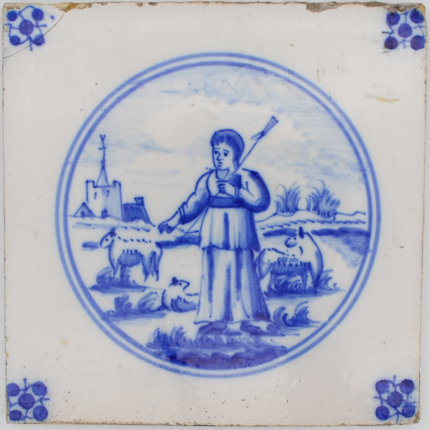
Shepard in a medallion| +/- 1770
€ 50,00A charming antique Delft tile featuring a shepherd surrounded by sheep in a tranquil natural setting. The central pastoral scene is enclosed within an elegant medallion, framed by large decorative spider corner motifs, a characteristic design element of 18th-century Dutch tile production.
The tile is in good condition with some glaze damage at the top rim.
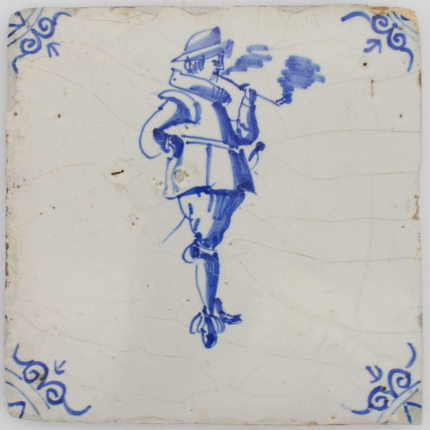
Pipe Smoker | +/- 1670
€ 150,00This charming Delft tile depicts a Dutchman standing, enjoying a tobacco pipe. The tile was made around 1670 in classical Delft style.
It is decorated with ‘ox-head’ corner motifs and overall is in good condition with some glaze damage across the surface and top right corner, representing part of its story.
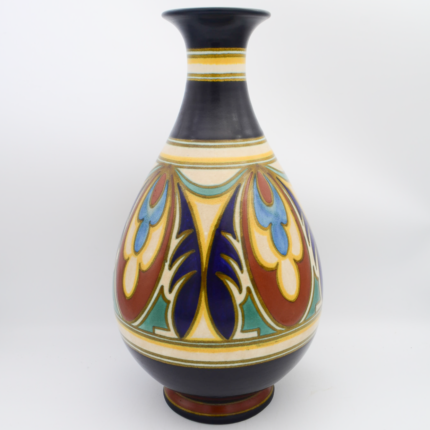
Large Art Deco Vase, Zuid-Holland, Gouda
€ 600,00This beautiful, large and full of colour Art Deco vase was produced in 1930 by Plateelbakkerij Zuid-Holland (PZH), a renowned pottery factory based in Gouda, the Netherlands. The piece features the “Ting” design, a hand-painted decorative motif characterised by geometric motifs and stylised scrolls in vibrant colours.
Plateelbakkerij Zuid-Holland, active from 1898 to 1965, became well known for its high-quality decorative ceramics and distinctive artistic style. The use of curved, flowing lines and repeated ornamental motifs is typical for this period.
The condition of the vase is excellent, with almost no signs of wear.
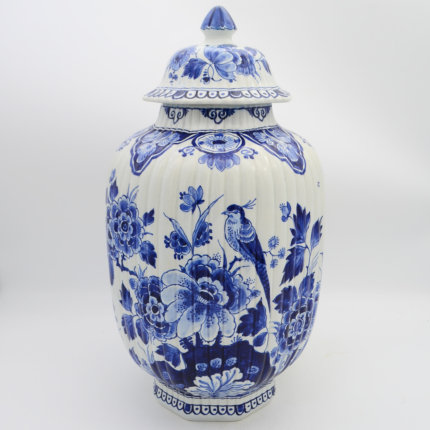
Lidded Peacock Vase, Royal Delft (De Porceleyne Fles), Delft
€ 600,00This beautifully hand-painted lidded vase was crafted by Royal Delft in 1955. The decor features a beautiful peacock surrounded by flowers, delicately painted. Currently, this shape and design are not being crafted anymore, making the vase a unique antique collectable.
The vase remains in perfect condition and features the official Royal Delft mark on the base, confirming its authenticity.
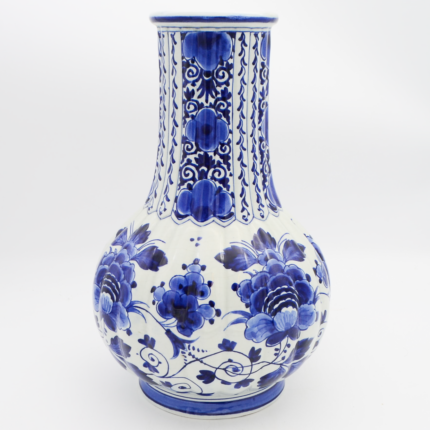
Large Flower Decor Vase, Royal Delft (De Porceleyne Fles), Delft
€ 500,00This beautifully hand-painted vase was crafted by Royal Delft in 1916. Currently, this shape and design are not being crafted anymore, making the vase a unique antique collectable.
The vase remains in perfect condition after more than 100 years and features the official Royal Delft mark on the base, confirming its authenticity.

Child rolling a hoop | +/- 1670
€ 80,00This Delft tile depicts a child playing with a hoop, a classic game for Dutch kids to play back in those days. The tile was made around 1670 and is decorated with the ‘volute’ corner motif, a less common one.
It is in good condition with restored corners.
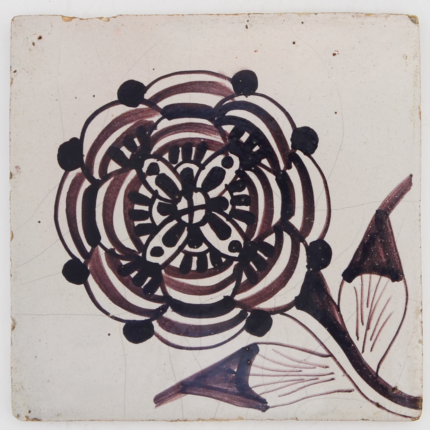
Manganese Rose | +/- 1800
€ 60,00This Delft wall tile in manganese was made during the 18th and 19th centuries. The tile depicts a rose on a stem. Four of this tile type create a small ornament.
The piece is in very good condition with small glaze cracks due to its old age.

“Napoleon” Flower Pot | +/- 1800
€ 50,00This antique Delft wall tile in blue with so-called ‘Napoleon’ flower pots was made at the bridge between the 18th and 19th centuries. The tile got its name as the shape of the pots reminds us of the famous bicorne hat that Napoleon wore (upside down).
The condition is excellent with some very small chips.

Noble Lady | +/- 1680
€ 90,00This Delft tile really takes us back to the 17th century, around 1680, as it shows a well-dressed lady in clothes typical for this time period. A large collar and a richly decorated dress. It might be that the lady depicted is part of a high-ranking family.
The tile is decorated with large ‘ox-head’ corner motifs and is overall in satisfactory condition, with a large part of the glaze missing on the right side, a symbol of its long journey.

Barking Dog | +/- 1660
€ 95,00This 17th-century Delft tile depicts a barking dog, delicately painted in blue. The animal is captured mid-barking, and the tile is decorated by Fleur-de-lis corner motifs with balusters at the side.
Dating from around 1660, the tile is in satisfactory condition, with visible missing glaze parts and reburbishment work in the bottom right corner, representing part of its story.

Excited Dog | +/- 1660
€ 300,00This antique Delft tile dates from around 1660 and depicts a scene of a dog being very excited. The picture is decorated with a ‘scalloped’ border and ‘Wanli’ inspired corner motifs.
It is overall in excellent condition, with some slightly visible refurbished corners.

Dutch Lady | +/- 1660
€ 125,00This antique Delft tile dates from around 1660 and depicts a scene of a woman facing away from us, possibly while walking on the street, dressed in a beautiful set of clothes typical of the 17th century.
The picture is decorated with a ‘scalloped’ border and ‘Wanli’ inspired corner motifs. It is overall in good condition, with some visible chips on the glaze surface and the 4 corners.

Flower Pot | +/- 1680 (3)
€ 150,00This antique Delft was made around 1680 and depicts a flower vase filled with charming flowers. The scene is captured in a ‘diamond square’, and the corners are decorated with the ‘fleur-de-lis’ motif.
The condition is very good for its age, with small signs of wear.

Flower Pot | +/- 1670
€ 100,00This beautiful Delft tile was made around 1670. It depicts a vase filled with flowers. Adorned with “ox head” corner motifs, this tile represents a classic flower pot design for its time.
The condition is good, with refurbishment work done at the corners.

Flower Pot | +/- 1680 (2)
€ 175,00An elegantly crafted Delft tile from circa 1680, featuring a beautifully adorned flower pot. At its centre is a tulip, flanked by two side flowers that subtly echo the popular ‘spider’ corner motif, adding to its rarity and charm.
The tile is further embellished with the distinctive ‘ox-head’ motif. A unique piece that is found in very good condition, with some small damage on the bottom left corner and some rim chips.

Pipe smoker | +/- 1680
€ 100,00This charming Delft tile depicts a Dutchman enjoying a tobacco pipe while sitting down. The tile was made around 1680 in classical Delft style.
It is decorated with ‘ox-head’ corner motifs and overall is in good condition with visible glaze damage across the whole surface, representing part of its story.

Dancing Man | +/- 1650
€ 200,00This antique Delft tile dates from around 1650 and depicts a scene of a man dancing. The picture is decorated with a ‘scalloped’ border and ‘Wanli’ inspired corner motifs.
It is overall in a good and pure condition, with some visible chips across the glaze surface and the top right corner.
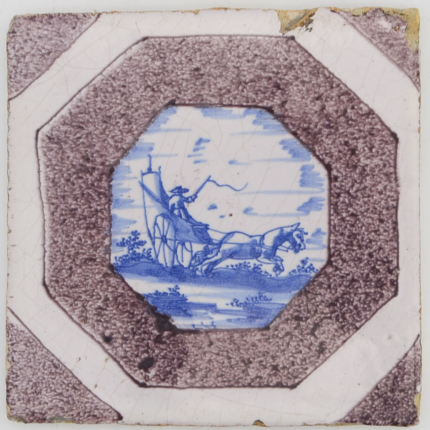
Horse and Carriage| +/- 1700
€ 100,00This authentic Dutch Delft tile dates to the end of the 17th century- beginning of the 18th century, circa 1700. It is made of tin-glazed earthenware and hand-painted in cobalt blue, featuring a horse-drawn carriage with a driver in a beautiful landscape scene.
The central motif is framed by a distinctive manganese (purple-brown) border. The tile is in good condition, with chips visible on the top right corner.
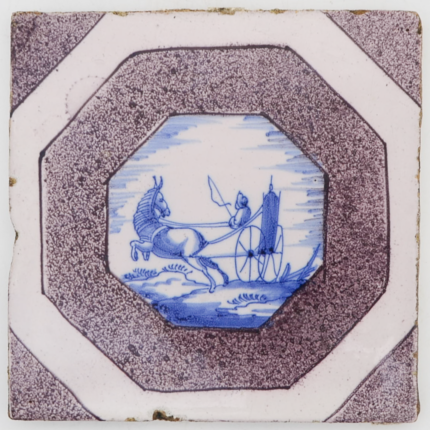
Horse and Carriage| +/- 1720
€ 120,00This authentic Dutch Delft tile dates to the end of the 17th century- beginning of the 18th century, circa 1720. It is made of tin-glazed earthenware and hand-painted in cobalt blue, featuring a horse-drawn carriage with a driver in a beautiful landscape scene.
The central motif is framed by a distinctive manganese (purple-brown) border. The tile is in very good condition for its age, with small chips visible on the bottom and left sides.
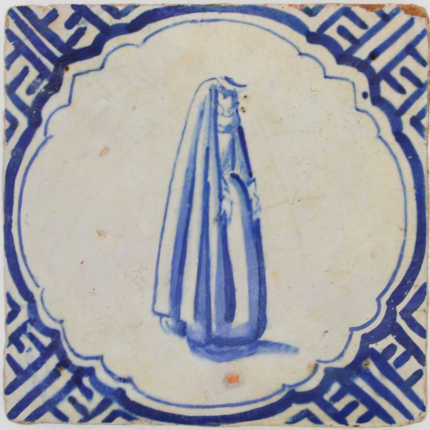
Lady wearing a huik | +/- 1650
€ 300,00This antique Delft tile, dating from the mid-17th century, depicts a lady dressed in a ‘huik’. A huik was often worn by ladies when they were mourning; however, in some Dutch communities, the huik was also worn when it was raining.
The corners feature the elegant Wanli motif, inspired by Chinese porcelain decoration. The tile remains in excellent condition with little refurbishment work done on the bottom area.

Alerted deer | +/- 1660
€ 200,00This charming antique Delft tile was made around 1660 and depicts an alerted deer, painted in a deep shade of blue. The picture is decorated with a medallion border and ‘Wanli’ inspired corner motifs.
It is overall in a good condition, with some visible chips across the glaze surface, and a refinished piece in the top right corner.

Swimming swan | +/- 1660
€ 150,00This charming antique Delft tile was made around 1660 and depicts a swan swimming peacefully, painted in a deep shade of blue. The picture is decorated with a medallion border and ‘Wanli’ inspired corner motifs.
It is overall in a satisfactory condition, with some visible chips across the glaze surface, sides and corners.

Jumping hare | +/- 1660
€ 275,00This charming antique Delft tile was made around 1660 and depicts a hare jumping, painted in a deep shade of blue. The picture is decorated with a medallion border and ‘Wanli’ inspired corner motifs.
It is overall in a good and pure condition, with some visible chips across the glaze surface and the top left corner.

Orange Fritillaria | +/- 1650
€ 125,00This Delft tile was made around 1650 and depicts a Fritillaria (Snake’s Head) flower in orange and green, with dotted petals. The scene is captured within a diamond-shaped square, and the corners are decorated with a stylised version of the ‘fleur-de-lis’ motif.
The tile is in good condition, although it was broken into pieces at some point. An excellent restoration has carefully put its story back together.

Deer Galloping | +/- 1680
€ 125,00This antique Delft tile was made around 1680 and depicts a deer galloping, probably away from danger. Adorned with “ox-head” corner motif, this piece is still in good condition, with some visible damage across the glaze surface and bottom line.

Frisian Flower Tableau | +/- 1750
€ 150,00This tile is a rare and beautiful example of a Frisian tile, depicting flowers native to the fauna in the north of the country and a stunning butterfly. The tile used to be part of a tableau with multiple connecting tiles. The tile was made in the second half of the 18th century, and it is still in excellent condition.
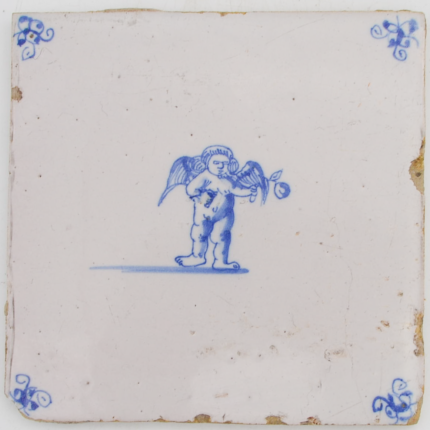
Cupid | +/- 1730
€ 100,00This beautiful Delft tile depicts Cupid standing straight and holding a flower. The tile is decorated with ‘spider’ corner motifs and is in good condition, with some chips visible on the bottom left corner and the right side.

Three Tulips | +/- 1650 (2)
€ 225,00This Delft tile, dating from around 1640, features a vibrant and detailed depiction of three tulips. The design showcases the tulips emerging from a single bulb, with evenly spaced leaves on either side. Created near the end of the ‘Tulip Mania’ period, when some tulip bulbs were worth as much as a canal house in Amsterdam, this tile reflects that fascinating time in Dutch history.
It also incorporates the ‘three-dot’ corner motif, which is derived from the symbol of the Trinity. The tile is in good condition, with some noticeable refurbishment work done across the glaze.
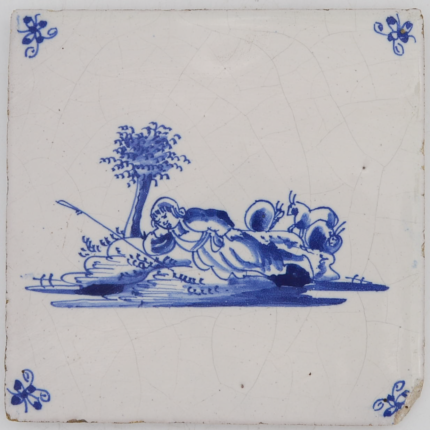
Female Shepard | +/- 1700
€ 70,00This charming Delft tile, made around 1700, depicts a peaceful pastoral scene featuring a female shepherd. She lays down in a field while sheep gather around her in the background, capturing a quiet moment of rural life.
The tile is framed with classic spider corner motifs, a common decorative element of the period. It remains in good condition overall, with only minor edge chips on the bottom right corner, consistent with its age.

Dutch Female Shepard | +/- 1770
€ 50,00This charming Delft tile, made around 1770, depicts a peaceful pastoral scene featuring a female shepherd. She stands in a field while sheep gather around her in the background, capturing a quiet moment of rural life.
The tile is framed with classic spider corner motifs, a common decorative element of the period. It remains in good condition overall, with only minor edge chips consistent with its age and a restored corner at the top right.

Fisherman | +/- 1680
€ 120,00This Delft tile, dating back to the late 17th century, is a beautiful example of the traditional Dutch farmlife. The painting features a fisherman holding his catch with a village in the background, surrounded by water. The corners feature the small “spider” motifs.
The condition of the piece is very good, with small chips along the red side.

Frisian Bird | +/- 1720
€ 70,00This tile from the early 18th century features a bird resting on a flower with a butterfly next to it in Frisian Delft style, with very delicate strokes in its design. Unlike many other Delft tiles, this one lacks corner motifs, placing full emphasis on the central decoration.
The tile is in very good condition, with some small wear on the surface. Hand-painted in cobalt blue on a white tin-glazed surface, it reflects the refined artistry of Friesland’s ceramic traditions. Tiles like this were commonly used to decorate kitchens and fireplaces.

Flower | +/- 1780
€ 80,00A central flower, painted with precise and delicate lines, occupies the centre of the tile and is complemented by the classic spider corner motifs.
In very good condition, with small signs of wear on the sides.

Bird on branch | +/- 1780
€ 60,00This tile from the late 18th century features a flower and a bird in Frisian Delft style, with very delicate strokes in its design. Unlike many other Delft tiles, this one lacks corner motifs, placing full emphasis on the central decoration.
The tile is in good condition, with visible wear on the surface. Hand-painted in cobalt blue on a white tin-glazed surface, it reflects the refined artistry of Friesland’s ceramic traditions. Tiles like this were commonly used to decorate kitchens and fireplaces.

Frisian Flower | +/- 1780
€ 70,00This tile from the late 18th century features a Frisian flower motif, showcasing intricate and delicate floral design. Unlike many other Delft tiles, this one lacks corner motifs, placing full emphasis on the central decoration.
The tile is in very good condition, with only minor wear. Hand-painted in cobalt blue on a white tin-glazed surface, it reflects the refined artistry of Friesland’s ceramic traditions. Tiles like this were commonly used to decorate kitchens and fireplaces.

Tiny House| +/- 1780
€ 70,00Beautiful late 18th-century Delft tile in the tiny decor style. A central house, painted with precise and delicate lines, occupies the centre of the tile, with no corner motifs, emphasising the main design.
In good condition.

Frisian Flower| +/- 1780
€ 50,00Beautiful late 18th-century Delft tile in the tiny decor style. A central flower, painted with precise and delicate lines, occupies the centre of the tile and is complemented by the classic spider corner motifs.
In good condition, with noticeable signs of wear on the sides.

Deer | +/- 1770
€ 60,00This Delft tile from around 1770 features a deer in motion, captured mid-hop. This type of ‘springertjes’ tiles were hugely popular in the second half of the 18th century.
The scene is enclosed within a circular frame, with the corners adorned by the classic “spider” motif. The tile is in good condition for its age, with glaze damage visible along the edges and restoration work present on the surface in the top-right corner.

Windmill | +/- 1770
€ 75,00This Delft tile, dating to around 1770, depicts a windmill surrounded by water and boats on all sides. The composition conveys a calm, scenic view, with careful attention to detail, characteristic of 18th-century Delft tile painting.
The corners are adorned with the classic “spider” motif. The tile remains in good condition for its age, with damage visible across the surface and on the bottom side, consistent with age and use.

Wandering Dog | +/- 1770
€ 70,00This Delft tile from around 1770 features a happily wandering dog. The scene is enclosed within a circular frame, with the corners adorned by the classic “spider” motif.
The tile is in very good condition for its age, with minimal glaze damage visible along the edges.

Happy Goat | +/- 1770
€ 60,00This Delft tile, dating to around 1770, features a goat, depicted in a lively and characteristic style. Goats were a familiar element of rural life in the Netherlands and were traditionally represented in the decorative arts of the period.
The design is enclosed within a circular frame, with the corners adorned by the classic “spider” motif. The tile is in good condition for its age, showing some signs of wear.

Round Vase, Mobach, Utrecht
€ 150,00Klaas Jan Mobach founded Mobach Keramiek in 1895, establishing a family-run ceramic workshop in Utrecht, Netherlands, that still exists today. Originally known as the Utrechtse Pottenfabriek, Mobach Keramiek has become renowned for its handcrafted vases and pots, distinguished by their innovative designs, exceptional quality, and blend of traditional techniques with modern influences.
Ceramic vase no. 695 is a notable example of Mobach Keramiek’s craftsmanship. Designed by Klaas Jan Mobach in the 1920s, this piece embodies the geometric shapes, bold lines, and contrasting colours that define the Art Deco style of the era. The vase is entirely hand-thrown and hand-finished.
The vase bears the model number 695 and has “Mobach Utrecht” engraved on its base, confirming its authenticity and origin. The piece is in very good condition.

Rabbit | +/- 1770
€ 70,00This Delft tile, dating to around 1770, features a seated rabbit. Rabbits and hares are traditional Dutch motifs, frequently depicted in this type of tiles, and reflecting their long-standing presence in the country’s fauna.
The design is enclosed within a circular frame, with the corners adorned by the classic “spider” motif. The tile is in excellent condition for its age, showing only minor signs of wear.

Camel | +/- 1770
€ 80,00This Delft tile, dating to around 1770, features a camel in motion. While camels are obviously not native to the Netherlands, their depiction reflects the period’s fascination with exotic animals, often inspired by travel accounts, trade routes, and books circulating in Europe at the time. Camel tiles are a rare find.
The design is enclosed within a circular frame, with the corners adorned by the classic “spider” motif. The tile remains in good condition for its age, with wear signs visible on the surface and corners.

Jug with stopper – Royal Delft -1963
€ 175,00This beautiful hand-painted lidded jug was produced by Royal Delft in 1963. It features a practical design with a cork fitted inside the lid, allowing the jug to close tightly and store liquids safely—a functional detail used in earlier periods of the factory’s production. The mark on the base confirms both its origin and date.
Although made in the mid-20th century, the jug follows the traditional Delftware style that has remained largely unchanged, reflecting the continuity and heritage of Dutch ceramic craftsmanship. The piece is in perfect condition.
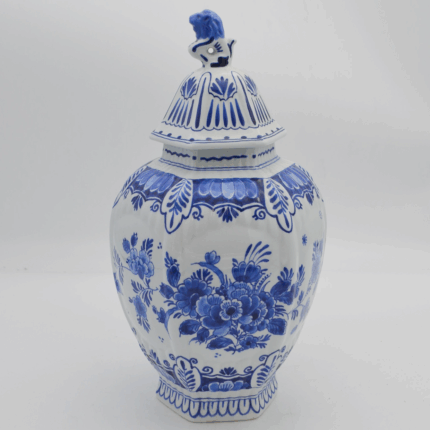
Lidded Vase – Royal Delft – 1969
€ 250,00This beautiful hand-painted lidded vase was produced by Royal Delft in 1969. It features a classic design that has been part of the factory’s ongoing production for many decades. The mark on the base confirms its origin and date.
While made in the late 20th century, the vase follows a traditional Delftware style that has remained largely unchanged, reflecting the continuity and heritage of Dutch ceramic craftsmanship.

Wall Plate – Royal Delft – 1956
€ 160,00This Royal Delft plate from 1956 features a vibrant design of flowers and birds, intricately hand-painted in the timeless Delftware style. The detailed artwork and lively composition make it a beautiful wall decorative piece.
The piece is in perfect condition.

Vase, decor ‘Rhodian’, Zuid-Holland, Gouda
€ 150,00Beautiful dark green matte-glazed Art Deco vase made by Plateelbakkerij Zuid-Holland (PZH), the most influential pottery factory in Gouda between 1898 and 1965. PZH became internationally known for its innovative glazes and richly decorated plateel, producing more decorative ceramics than any other local workshop.
This piece reflects the factory’s shift from Art Nouveau to early Art Deco, with its deep matte colour and simplified, modern forms. The Rhodian decor was one of the first designs released in the first decade of the century and drew from Middle Eastern and Ottoman ceramic traditions. Typical features include stylised scrolls, floral motifs, and rhythmic repeating patterns—elements that made PZH’s work world-famous.
The marks on the base identify the factory, the artist, and the production year, confirming the jug’s authenticity. There is a noticeable chip on the rim.

Vase, decor ‘Max’, Zuid-Holland, Gouda
€ 120,00This beautiful green Art Deco vase was produced in 1919 by Plateelbakkerij Zuid-Holland (PZH), a renowned pottery factory based in Gouda, the Netherlands. The piece features the “Max” design, a hand-painted decorative motif characterised by flowers, stylised scrolls, and rhythmical patterns in vibrant colours, including ochre yellow, olive green, red, and blue.
Plateelbakkerij Zuid-Holland, active from 1898 to 1965, became well known for its high-quality decorative ceramics and distinctive artistic style. The “Max” decor reflects the early post-war aesthetic, combining traditional craftsmanship with stylistic influences from the factory’s earlier celebrated designs, such as the ‘Rhodian’ series. The use of curved, flowing lines and repeated ornamental motifs is typical for this period.
The condition of the vase is excellent, with normal signs of wear for its age

Flower Plate, decor ‘Juliette’, Zuid-Holland, Gouda
€ 85,00This small plate, produced in 1942 by the Zuid-Holland factory in Gouda, decor ‘Juliette’, reflects the refined artistry of one of the leading makers of matte-glazed ceramics in the early 20th century. The design features a matte decoration of leaves combined with a glossy finish for the background and flower petals in rich orange-beige tones accented with dark green and yellow. The leaves were painted over the glaze, creating a subtle raised texture that brings the motif to life when touched.
The plate has survived in excellent condition.

Dutch Dove House |+/- 1720
€ 85,00This Delft tile, dating back to the early 18th century, is part of a collection that was once part of an old house in Antwerp. It illustrates a Dutch dovecote surrounded by water and a village in the background. What makes this tile stand out is the level of detail in its design. Compared to earlier models, the brush lines are finer, and the details are much more intricate.
The corners feature the small “spider” motifs. The tiles have been painted as a set over 300 years ago, and you can see how well they fit together in both colour and design. These tiles would work beautifully in a modern interior design project or as a unique framed piece of wall art.
In the gallery, you can see how the tiles look when assembled, showcasing their harmonious design and the skill of their craftsmanship. We offer single and double framing options for tiles; see image 6 for an example. Contact us on Instagram or Email for more information.

Dutch House |+/- 1720 (9)
€ 85,00This Delft tile, dating back to the early 18th century, is part of a collection that was once part of an old house in Antwerp. It illustrates a Dutch farmhouse surrounded by water. What makes this tile stand out is the level of detail in its design. Compared to earlier models, the brush lines are finer, and the details are much more intricate.
The corners feature the small “spider” motifs. The tiles have been painted as a set over 300 years ago, and you can see how well they fit together in both colour and design. These tiles would work beautifully in a modern interior design project or as a unique framed piece of wall art.
In the gallery, you can see how the tiles look when assembled, showcasing their harmonious design and the skill of their craftsmanship. We offer single and double framing options for tiles; see image 6 for an example. Contact us on Instagram or Email for more information.

Leaf Plate, decor ‘Bladeren’, Zuid-Holland, Gouda
€ 300,00This absolutely stunning deep plate, produced in 1924 by the Zuid-Holland factory in Gouda, decor ‘bladeren’, reflects the refined artistry of one of the leading makers of matte-glazed ceramics in the early 20th century. The design features a matte decoration of grapes and leaves in rich brown tones accented with electric blue. The leaves were painted over the glaze, creating a subtle raised texture that brings the motif to life when touched.
From 1908 onward, N.V. Koninklijke Plateelbakkerij Zuid-Holland developed its distinctive matte glaze known as matt plateel. Presented at the Leipzig Fair in 1910 and the San Francisco World’s Fair in 1915, these designs were inspired by ancient Greek and Persian ornament and often given evocative names such as Rhodian, Damascus, Salak, and Purdah. Matt Plateel represented a shift away from the flowing lines of Art Nouveau, mirroring the changing artistic sensibilities of the early 20th century.
This example has survived in excellent condition—remarkably well-preserved after more than a century.

Spiral Vase, decor ‘Japara’, Regina, Gouda
€ 250,00This striking Plateel spiral vase, produced by the Regina factory in the 1920s, is an exceptional example of early 20th-century Dutch ceramic design. The piece features a gently twisting form decorated with hand-painted motifs in rich tones of dark and light brown, complemented by white, orange, and blue. The balanced interplay of colour and pattern is characteristic of Regina’s expressive Art Deco style.
The vase reflects the factory’s distinctive craftsmanship and artistic ambition, which placed Regina among the leading Dutch potteries of its time. It remains in excellent condition, with only minor glaze irregularities consistent with age.

Dutch Village |+/- 1720
€ 85,00This Delft tile, dating back to the early 18th century, is part of a collection that was once part of an old house in Antwerp. It illustrates a Dutch village surrounded by trees and boats on the water. What makes this tile stand out is the level of detail in its design. Compared to earlier models, the brush lines are finer, and the details are much more intricate.
The corners feature the small “spider” motifs. The tiles have been painted as a set over 300 years ago, and you can see how well they fit together in both colour and design. These tiles would work beautifully in a modern interior design project or as a unique framed piece of wall art.
In the gallery, you can see how the tiles look when assembled, showcasing their harmonious design and the skill of their craftsmanship. We offer single and double framing options for tiles; see image 6 for an example. Contact us on Instagram or Email for more information.

Dutch House |+/- 1720 (5)
€ 85,00This Delft tile, dating back to the early 18th century, is part of a collection that was once part of an old house in Antwerp. It illustrates a Dutch farmhouse surrounded by water. What makes this tile stand out is the level of detail in its design. Compared to earlier models, the brush lines are finer, and the details are much more intricate.
The corners feature the small “spider” motifs. The tiles have been painted as a set over 300 years ago, and you can see how well they fit together in both colour and design. These tiles would work beautifully in a modern interior design project or as a unique framed piece of wall art.
In the gallery, you can see how the tiles look when assembled, showcasing their harmonious design and the skill of their craftsmanship. We offer single and double framing options for tiles; see image 6 for an example. Contact us on Instagram or Email for more information.
If you would like to purchase the other 3 tiles too, here are the website links:
https://blauweroos-antiek.nl/product/dutch-house-1700-3

Dutch House |+/- 1720 (4)
€ 85,00This Delft tile, dating back to the early 18th century, is part of a collection that was once part of an old house in Antwerp. It illustrates a Dutch farmhouse surrounded by water. What makes this tile stand out is the level of detail in its design. Compared to earlier models, the brush lines are finer, and the details are much more intricate. The corners feature the small “spider” motifs.
The tiles have been painted as a set over 300 years ago, and you can see how well they fit together in both colour and design. These tiles would work beautifully in a modern interior design project or as a unique framed piece of wall art.
In the gallery, you can see how the tiles look when assembled, showcasing their harmonious design and the skill of their craftsmanship. We offer single and double framing options for tiles. Contact us on Instagram or Email for more information.
If you would like to purchase the other 3 tiles too, here are the website links:
https://blauweroos-antiek.nl/product/dutch-house-1700-3

Dutch Bridge |+/- 1720 (4)
€ 85,00This Delft tile, dating back to the early 18th century, is part of a collection that was once part of an old house in Antwerp. It illustrates a bridge with boats and a village in the distance. What makes this tile stand out is the level of detail in its design. Compared to earlier models, the brush lines are finer, and the details are much more intricate.
The corners feature the small “spider” motifs. The tiles were painted as a set over 300 years ago, and you can see how well they fit together in both colour and design.
These tiles would work beautifully in a modern interior design project or as a unique framed piece of wall art. In the gallery, you can see how the tiles look when assembled, showcasing their harmonious design and the skill of their craftsmanship. We offer single and double framing options for tiles. Contact us on Instagram or Email for more information.
If you would like to purchase the other 3 tiles too, here are the website links:
https://blauweroos-antiek.nl/product/dutch-well-1700

Dutch Windmill |+/- 1720 (2)
€ 85,00This Delft tile, dating back to the early 18th century, is part of a collection that was once part of an old house in Antwerp. It illustrates a windmill surrounded by water and a village in the distance. What makes this tile stand out is the level of detail in its design. Compared to earlier models, the brush lines are finer, and the details are much more intricate.
The corners feature the small “spider” motifs. The tiles have been painted as a set over 300 years ago, and you can see how well they fit together in both colour and design. These tiles would work beautifully in a modern interior design project or as a unique framed piece of wall art.
In the gallery, you can see how the tiles look when assembled, showcasing their harmonious design and the skill of their craftsmanship. We offer single and double framing options for tiles; see image 6 for an example. Contact us on Instagram or Email for more information.
If you would like to purchase the other 3 tiles too, here are the website links:
https://blauweroos-antiek.nl/product/dutch-well-1700
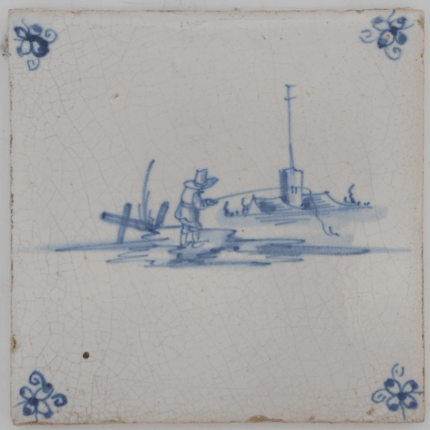
Dutch Fisherman |+/- 1720 (3)
€ 85,00This Delft tile, dating back to the early 18th century, is part of a collection that was once part of an old house in Antwerp. It illustrates a Dutch fisherman with a village noticeable in the distance. What makes this tile stand out is the level of detail in its design. Compared to earlier models, the brush lines are finer, and the details are much more intricate.
The corners feature the small “spider” motifs. The tiles have been painted as a set over 300 years ago, and you can see how well they fit together in both colour and design.
These tiles would work beautifully in a modern interior design project or as a unique framed piece of wall art. In the gallery, you can see how the tiles look when assembled, showcasing their harmonious design and the skill of their craftsmanship.
If you would like to purchase the other 3 tiles too, here are the website links:
https://blauweroos-antiek.nl/product/dutch-house-1700-6

Pot with Lid, decor ‘Marga’, Zuid-Holland, Gouda
€ 200,00This small pot, made in 1923 by Plateelbakkerij Zuid-Holland in Gouda, is decorated with a matte glaze in turquoise, green, and orange-yellow. The piece is characteristic of early Dutch Art Deco ceramics, with its simple form and restrained but vivid colour palette.
Plateelbakkerij Zuid-Holland was the largest pottery in Gouda at the time and is especially associated with stylised floral designs produced between 1900 and 1924. This example is marked on the base with both the factory stamp and the painter’s signature.
It has survived in excellent condition after more than a century.

Dutch Fisherman |+/- 1720 (2)
€ 85,00This Delft tile, dating back to the early 18th century, is part of a collection that was once part of an old house in Antwerp. It illustrates a Dutch fisherman with a village noticeable in the distance. What makes this tile stand out is the level of detail in its design. Compared to earlier models, the brush lines are finer, and the details are much more intricate.
The corners feature the small “spider” motifs. The tiles have been painted as a set over 300 years ago, and you can see how well they fit together in both colour and design. These tiles would work beautifully in a modern interior design project or as a unique framed piece of wall art.
In the gallery, you can see how the tiles look when assembled, showcasing their harmonious design and the skill of their craftsmanship. We offer single and double framing options for tiles; see image 6 for an example. Contact us on Instagram or Email for more information.
If you would like to purchase the other 3 tiles too, here are the website links:
https://blauweroos-antiek.nl/product/dutch-windmill-1700
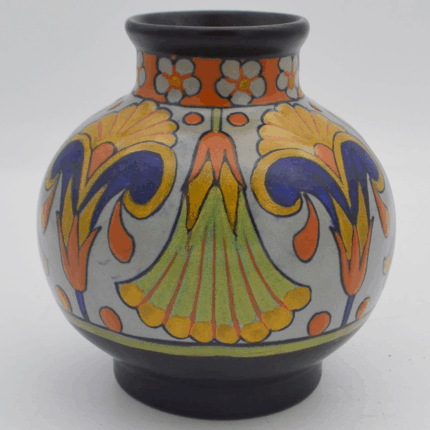
Vase, decor ‘Lotus’, Zuid-Holland, Gouda
€ 80,00This delicate vase was made in 1924 by Plateelbakkerij Zuid-Holland, a well-known pottery factory based in Gouda, the Netherlands. The design is named “Lotus”, a hand-painted decorative pattern featuring stylised floral and abstract elements in bold colours such as ochre yellow, olive green, teal, purple, and deep blue.
Zuid-Holland, sometimes referred to as PZH, was active from 1898 until 1965 and gained a reputation for producing high-quality decorative ceramics. The “Lotus” design is typical of the interbellum period, combining traditional craftsmanship with mid-1920s stylistic elements.
The condition is very good with a small chip visible on the top rim.

Vase, decor ‘Lotus’, Regina, Gouda
€ 125,00Leaf-inspired small-sized vase with powerful nuances of blue, yellow and brown, in Art Deco Matte style, model “lotus”. The piece was made between 1927 and 1935, according to the markings on the bottom. Regina factory was formed in 1898 and named after Queen Wilhelmina. Their creations rose to the standard of perfection and were the true premiums of those days. Both the original factory signature and style are visible on the bottom.
The piece is in excellent condition.

Kid in a sleetje – Royal Delft – 1983
€ 90,00This charming Royal Delft tile, made in 1983, depicts a playful winter scene of a child sliding down a traditional Dutch sleetje (sled). Hand-painted in cobalt blue on a white tin-glazed surface, it showcases the timeless craftsmanship of Royal Delft. While the Delft factory continues to produce hand-painted tiles, this particular design has been discontinued.
The piece is in perfect condition and comes complete with its frame.

Frisian Flower | +/- 1770
€ 80,00This antique late-18th-century Delft blue tile features a traditional Frisian flower motif, admired for its finely detailed and elegant design. Unlike many Delft tiles of the period, it is notable for the absence of corner motifs.
The tile is in good condition for its age, with signs of wear.
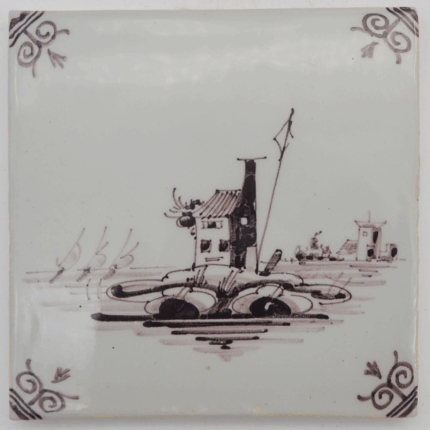
Dutch House – Makkum – 1976
€ 50,00A rare and finely hand-painted Makkum tile, made in 1976, depicting a typical Dutch farmhouse beside a calm body of water filled with boats in the distance. The scene is rich in detail and tradition, framed by classic ox-head corner motifs.
This tile is painted in a distinctive purple tone, achieved using manganese oxide—which was introduced in the 18th century as an alternative to the more common cobalt oxide blue. Manganese was used to create warmer, more subdued hues, adding a unique character to the piece.
The tile is in excellent condition, showing only minimal signs of age.

Dog – Makkum – 1972
€ 75,00A stunning and rare Makkum tile, made in 1972, featuring an alarmed dog painted in the traditional 17th-century Delft style. The central image is set within an orange diamond-shaped border, with the dog standing on a grassy field. In each corner, delicate motifs—executed in the classic reserve technique (uitgespaarde hoek)—highlight the tile’s detailed, hand-painted craftsmanship.
The tile is in excellent condition after more than 50 years, with only some minor chips on the edges.
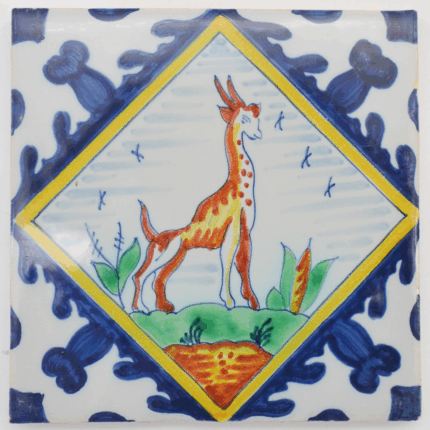
Giraffe – Makkum – 1999
€ 85,00A beautiful and very rare Makkum tile, made in 1999, featuring an elegant giraffe painted in the traditional Delft style of the 17th century. The central image is framed by an orange diamond-shaped border, with the giraffe standing on a grassy field. Delicate corner motifs, executed using the traditional ‘reserve technique’ shape (uitgespaarde hoek), complete the design and reflect the tile’s careful hand-painted craftsmanship.
The condition of the tile is excellent, with just a minor chip on the right border.

Flower Pot | +/- 1650
€ 125,00This 17th-century blue and white Delft tile features a central image of a stylised flower pot, framed within a diamond outline. Each corner is decorated with a fleur-de-lis (French lily) motif, a common ornamental element in Dutch tilework of the period.
Dating to around 1650, the tile is made of tin-glazed earthenware. It shows signs of age, including chipped edges and surface cracking, and has undergone some refurbishment. These features are typical for ceramics of this age and speak to its long history of use and preservation —, beautiful example of everyday decorative art from the Dutch Golden Age.

Round Jug, Mobach, Utrecht
€ 150,00This beautifully round abstract-shaped jug, model no. 482 was crafted by Mobach Keramiek in Utrecht during the second quarter of the 20th century. It is marked on the base with “Mobach, Utrecht” and the model number, confirming its origin and authenticity.
Founded in 1895 by Klaas Jan Mobach, Mobach Keramiek began as the ‘Utrechtse Pottenfabriek’ and grew into a respected name in Dutch ceramic art, which is still in operation today. The family-run workshop became known for its distinctive vases and vessels, blending traditional craftsmanship with evolving modern styles.
Model 482 is a fine example of the Art Deco influences that shaped Mobach’s work in the 1930s. Characterised by clean geometric lines and restrained form, this piece reflects both the artistic sensibilities of the era and the meticulous hand-finishing typical of Mobach creations.
Made from high-quality earthenware and finished in a dark beige-grey glaze, the jug remains in perfect vintage condition.

Pastoral scene | +/- 1750
€ 100,00This beautiful Delft tile, dating to around 1750, features a pastoral scene in which a female shepherd is approaching a man. In the background, sheep are visible, adding to the rural atmosphere, and a beautiful tree, delicately painted, fills the left corner.
Framed by traditional ox-head corner motifs, the tile reflects the decorative style of its time. It is in very good overall condition, with only minor signs of age.
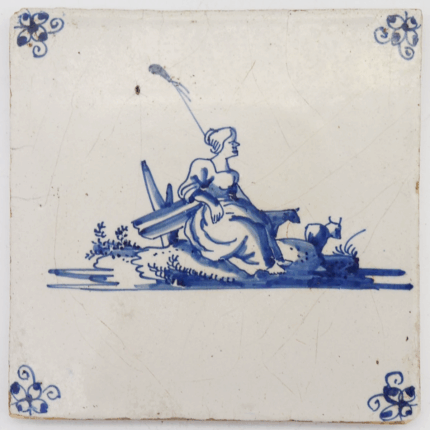
Female Shepard | +\- 1720
€ 125,00This charming Delft tile, made around 1720, depicts a peaceful pastoral scene featuring a seated female shepherd. She rests on a bench while sheep gather around her in the background, capturing a quiet moment of rural life.
The tile is framed with classic ox-head corner motifs, a common decorative element of the period. It remains in very good condition overall, with only minor edge chips consistent with its age.

Three tulips | +/- 1680
€ 150,00This Delft tile features a tulip, one of the most recognisable symbols of the Netherlands. It dates to shortly after the period known as tulip mania—an early example of a speculative financial bubble in European history.
The piece is in good overall condition, where damage is consistent with age.

Cigarette pot, decor ‘Tagora’, Regina, Gouda
€ 95,00This colourful, leaf-inspired Plateel pot, made by the renowned Regina factory in the 1920s, is a fine example of early 20th-century Dutch ceramic craftsmanship. Like many plateel factories of the time, Regina began with pipe production and gradually shifted toward ceramics—often continuing to include tobacco-related items in their collections. The pot was meant to be a cigarette holder.
The pot’s graceful shape and rich glaze reflect the distinctive style and skill of Regina’s artisans, who played an important role in shaping the Dutch ceramics landscape of the period. The piece remains in very good condition, with minor glaze irregularities typical for its age.

Dutch landscape – Makkum – 1970s
€ 50,00A beautifully hand-painted Makkum tile, made in the 1970s, featuring a serene Dutch landscape. In the distance, a traditional farmhouse and several boats can be seen, set against an open sky and calm water—capturing the quiet charm of the Dutch countryside.
Executed in deep cobalt blue, the scene reflects the long-standing Delft tradition of using cobalt oxide to achieve its vibrant and enduring hue. The composition is framed by classic ox-head corner motifs.
The tile is in excellent condition, with only minor signs of age appropriate for its time.
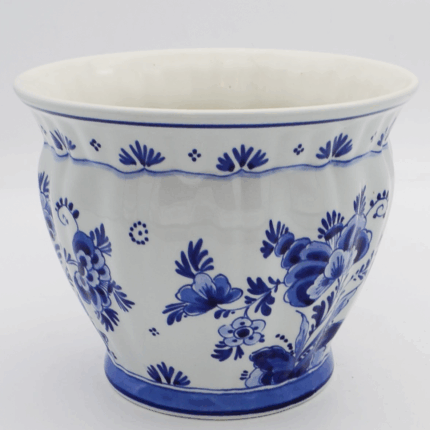
Bowl – Royal Delft – 1989
€ 150,00This beautiful hand-painted bowl was made by Royal Delft in 1989 and reflects a long tradition of Dutch ceramics. Large bowls like this were often used as decorative pieces on tables and cupboards. The mark on the base confirms its authenticity and the year of fabrication.
Even though it was made in the late 20th century, the bowl follows the classic Delftware style, showing the lasting heritage and craftsmanship of Royal Delft.
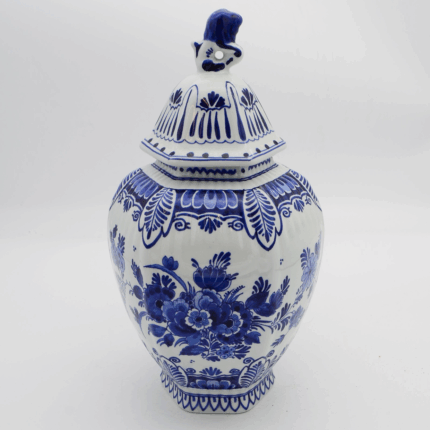
Lidded Vase – Royal Delft – 1978
€ 250,00This beautiful hand-painted lidded vase was produced by Royal Delft in 1978. It features a classic design that has been part of the factory’s ongoing production for many decades. The mark on the base confirms its origin and date.
While made in the late 20th century, the vase follows a traditional Delftware style that has remained largely unchanged, reflecting the continuity and heritage of Dutch ceramic craftsmanship.

Flower Plate, decor ‘Rigi Royal’, Zuid-Holland, Gouda
€ 180,00This ceramic plate was produced in the 1950s by Plateelbakkerij Zuid-Holland, a renowned pottery factory located in Gouda, the Netherlands. The design is named “Rigi Royal”, a hand-painted decorative pattern featuring stylised floral and abstract elements in bold colours such as ochre yellow, olive green, teal, purple, and deep red.
Zuid-Holland, sometimes referred to as PZH, was active from 1898 until 1965 and gained a reputation for producing high-quality decorative ceramics. The factory was granted the right to use the title “Royal” in 1930, and its later work—including pieces like this—continued the tradition of richly colored, ornamental design that had become associated with Gouda pottery.
The “Rigi Royal” design is typical of the post-war period, combining traditional craftsmanship with mid-century stylistic elements. It reflects the continuing influence of earlier Art Nouveau and Art Deco movements, interpreted in a more modern, expressive form.

Large Round Vase – Royal Delft – 1929
€ 800,00This beautifully shaped lidded vase was crafted by Royal Delft in 1929, part of a tradition dating back to 1653, when the factory began producing its iconic Delft Blue pottery. Inspired by the cabinet sets popular in the 18th century, such vases were proudly displayed on the hoods of cabinets — symbols of refinement and taste.
Richly decorated with traditional hand-painted floral motifs, the vase features a full, rounded form with a sculptural lid, characteristic of Royal Delft’s enduring craftsmanship. Remarkably, this same model is still in production today, testifying to its timeless design.
In excellent condition, this piece has stood the test of nearly a century.
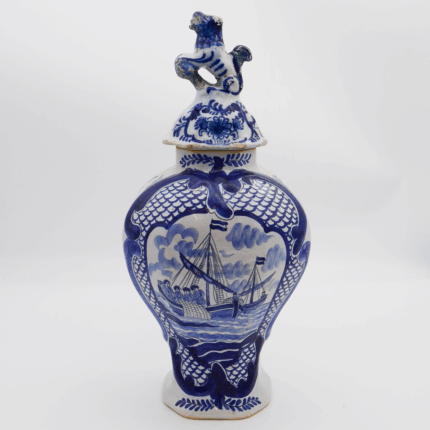
Delftware vase with Ship
€ 275,00Beautiful 19th-century Delftware vase, hand-painted in rich cobalt blue with a detailed Dutch ship scene and decorative lattice framing. The lid is topped with a striking lion finial, a classic symbol of strength in Dutch ceramics.
In good condition for its age, with gentle wear, notable refurbishment work on the lid and fine crazing typical of 19th-century Delftware.

Dutch Castle – Makkum – 1970s
€ 50,00This beautifully crafted Makkum tile features a detailed depiction of a Dutch castle house, rendered in classic Delft blue and white. The tile is meticulously hand-painted on a white tin-glazed surface, offering a smooth, glossy finish.
Produced by the Royal Tichelaar factory in Makkum, this piece reflects a ceramic legacy that dates back to 1572. Renowned for its dedication to traditional craftsmanship, Tichelaar played a pivotal role in building and preserving the rich ceramic heritage of Friesland.
With tile production ceasing in 2013, this tile is a rare and authentic collectable that embodies the artistry and history of Dutch ceramics.
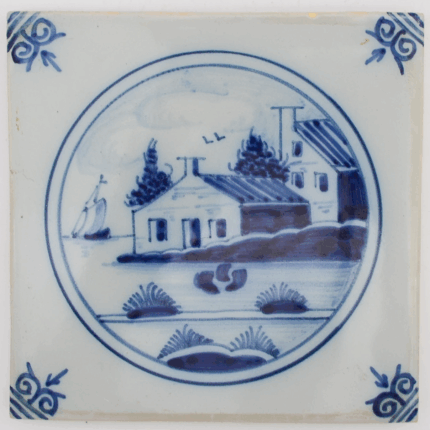
Farm House – Makkum – 1980s
€ 50,00A beautifully crafted Makkum tile featuring a detailed Dutch farm house in classic Delft blue and white. The design is hand-painted on a white tin-glazed surface, with a smooth, glossy finish.
This tile was produced by Tichelaar pottery in Makkum, a family-run factory with a history dating back to 1572. Renowned for its exceptional craftsmanship and dedication to traditional techniques, Tichelaar preserved the rich ceramic heritage of Friesland for centuries. As the factory ceased tile production in 2013, this piece stands out as a rare collectable.
The condition is perfect.
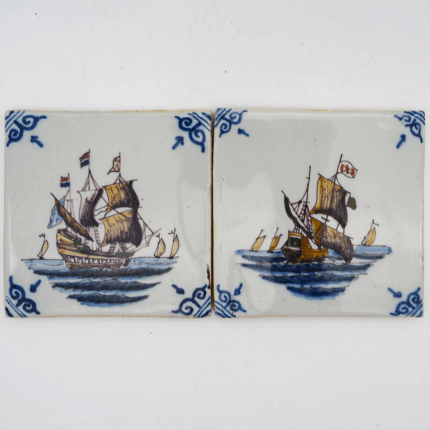
Dutch Ships – Makkum – 1960s
€ 60,00This beautifully crafted pair of Makkum tiles features intricate depictions of traditional Dutch trading ships, rendered in classic Delft blue and accented with vivid colours. The designs are meticulously hand-painted on a white tin-glazed surface, resulting in rich colours and a smooth, glossy finish.
Produced by the historic Tichelaar pottery in Makkum during the 1960s, these tiles are a testament to a ceramic legacy dating back to 1572. Renowned for its exceptional craftsmanship, Tichelaar preserved the rich ceramic traditions of Friesland through dedication to time-honored techniques.

Small Pot, decor ‘Panan’, Regina, Gouda
€ 70,00This stunning plateel pot, crafted by the renowned Regina factory in the 1920s, is a remarkable example of early 20th-century Dutch ceramic artistry. It features a graceful three-legged base and beautifully hand-painted designs, showcasing the vibrant colours and intricate patterns that define the Plateel style.
The pot’s elegant form and bold glaze embody the exceptional craftsmanship and creative vision of the Regina factory, a key player in Dutch ceramics during this period.
The piece is in very good condition with the expected glaze imperfections due to its age.

Small Flower Plate – Royal Delft – 1976
€ 85,00This classic small plate is a beautifully hand-painted piece adorned with nature-inspired motifs, including flowers, leaves, and a tree. Produced by Royal Delft in 1976, it remains a beloved design still in production today.
The official factory mark on the base verifies its authenticity, showcasing its connection to one of Delft’s most renowned pottery makers. A timeless addition to any collection or display.
The condition is perfect.
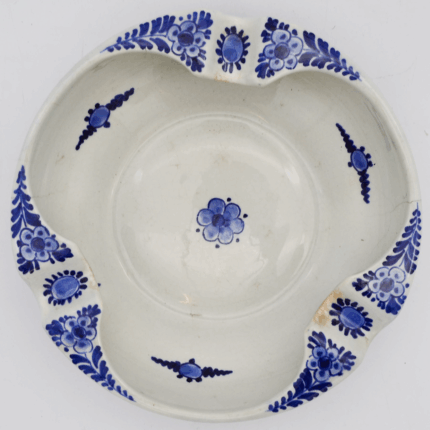
Large Flower Ashtray – Royal Delft – 1953
€ 100,00This ashtray is a beautifully hand-painted piece featuring delicate floral designs, produced by Royal Delft in 1953. No longer in production, it is a rare and unique find. The official factory mark on the base verifies its authenticity, ensuring its origin from one of Delft’s most renowned pottery makers.
The condition is good with some discoloured signs of wear and a surface scratch on the inside.
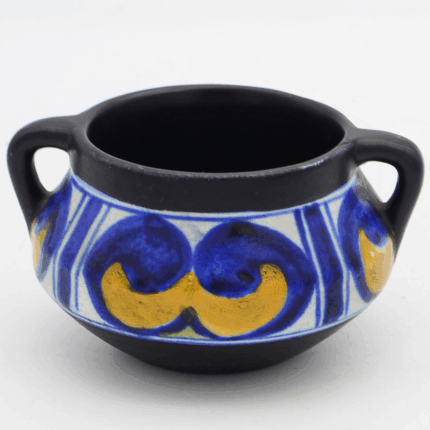
Small Pot, decor ‘Simpie’, Zuid-Holland, Gouda
€ 50,00This beautiful small pot, created in 1922, showcases a blue and black electric matte glaze pattern in a beautiful example of Art Deco ceramics. With its original form and elegance intact, it highlights the enduring craftsmanship of Plateelbakkerij Zuid-Holland. As Gouda’s largest pottery, Zuid-Holland dominated the market with its decorative pieces, particularly known for its darker, stylised floral patterns produced between 1900 and 1924.
This piece features factory marks and the artist’s signature on the base. Remarkably, the vase remains in perfect condition after over a century.

Small Vase, decor ‘Teheran’, Regina, Gouda
€ 120,00Floral-inspired small-sized vase with powerful nuances of blue, in Art Deco Matte style, model “teheran”. The piece was made in the years between 1927 and 1935, according to the markings on the bottom. Regina factory was formed in 1898 and named after Queen Wilhelmina. Their creations rose to the standard of perfection and were the true premiums of those days. Both the original factory signature and style are visible on the bottom.
The condition is excellent.

Set of Lidded Vases – Royal Delft – 1968/1976
€ 350,00This delicate set of small lidded vases was produced by Royal Delft in 1968 and 1976. With a history dating back to 1653, Royal Delft has a long tradition of crafting high-quality Delft Blue pottery. Interestingly, the 18th century saw a surge in the popularity of lidded jars, with ten different types being introduced. These vases, adorned with intricate floral patterns, have endured through the years and remain in production today.
The set is in perfect condition and features the original factory stamp on the base.

Candle Holder – Royal Delft – 1966
€ 150,00This candleholder is a beautifully hand-painted piece featuring a classic design produced by Royal Delft in 1966. It’s no longer in production, making it a unique find.
The official factory mark on the base verifies its authenticity. The craftsmanship and design are characteristic of Royal Delft’s work.
The condition of the item is perfect.
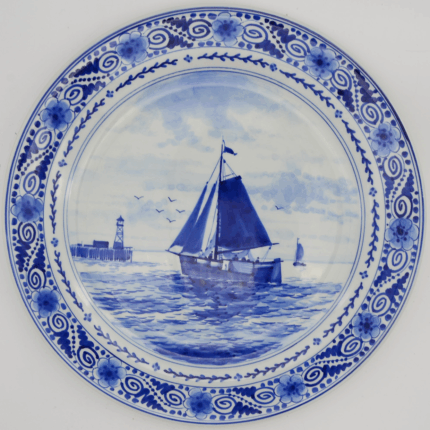
Wall Plate with Ship – Royal Delft – 1974
€ 250,00This plate shows a typical Dutch seascape with ships and a lighthouse. It was made by Royal Delft in 1974 and is an example of a classic design that is still in production today.
The plate has the factory’s official stamp on its base, as well as the year mark and the initials of the painter. It is in perfect condition.

Wall Plate with Windmill – Royal Delft – 1974
€ 250,00This plate shows a typical Dutch landscape with a windmill as its main feature. It was made by Royal Delft in 1974 and is an example of a classic design that is still being made today. The rim has a floral decoration that is commonly used on Delft Blue plates.
The plate has the factory’s official stamp on the base, which confirms it is authenticity. This type of plate continues to be popular and is still being made today.
The condition is perfect.

Pot with Lid – Royal Delft – 1950
€ 150,00This medium lidded vase by Royal Delft, produced in 1950, exemplifies one of the timeless classic designs that continues to be crafted today.
The vase features the official factory stamp on its base, certifying its authenticity and heritage. Its durable design and skilled craftsmanship are characteristic of Royal Delft.
The condition is good with notable refurbishments at the neck and lid.

Jumping Dog | +/- 1670
€ 250,00This Delft tile, crafted around 1670, portrays a delicate depiction of a jumping dog. The scene is framed by an accolade-shaped border and complemented by ‘winged-leaf’ corner motifs. The background features a detailed landscape adorned with flowers and dotted terrain, showcasing a rare and distinctive tile style typical of the mid-17th century.
The tile is in overall good condition, with minor wear visible on the bottom-left corner.
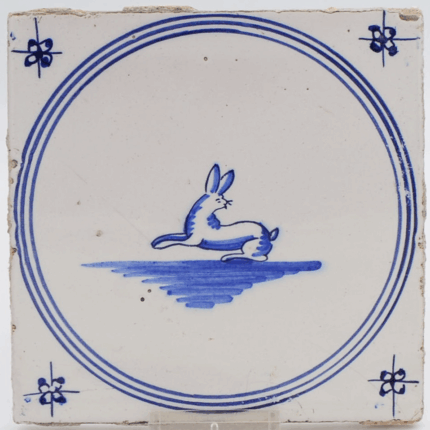
Hare | +/- 1780
€ 65,00This Delft tile, dating to around 1780, features a hare in motion, characteristic of the iconic ‘springer’ type. Hares are a traditional Dutch motif, often depicted in this style, reflecting their long-standing presence in the country’s fauna.
The design is enclosed within a circle, with the corners adorned by the classic ‘spider’ motif. The tile is in excellent condition for its age, with only minor wear visible on the top-right corner.
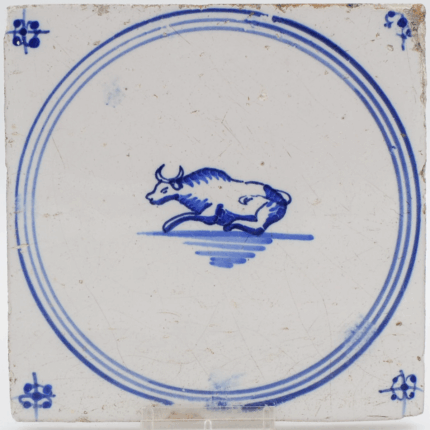
Bull | +/- 1780
€ 90,00This Delft tile, dating to around 1780, depicts a resting bull, which is a rare illustration for this type of tiles.
The design is framed within a circle, with the corners featuring the classic ‘spider’ motif. While the tile remains in good condition for its age, there is some damage along the bottom rim and the top-right corner.

Flower Pot | +/- 1680
€ 150,00An elegantly crafted Delft tile from circa 1680, featuring a beautifully adorned flower pot. At its centre is a tulip, flanked by two side flowers that subtly echo the popular ‘spider’ corner motif, adding to its rarity and charm. The tile is further embellished with the distinctive ‘ox-head’ motif.
A unique piece that is found in overall good condition, with a small damage on the left bottom corner and some rim chips.

Biblical Scene – Makkum – 1970s
€ 90,00This detailed Makkum tile from 1976 portrays a biblical scene from the village of Nain, where Jesus encounters a funeral procession for a widow’s only son. The tile captures the moment Jesus, moved by compassion, raises the young man from the dead. This depiction reflects a story of profound hope and restoration, highlighting themes of empathy and divine intervention.
The tile is in perfect condition after 49 years.

Lidded Sunflower Vase, De Distel, Amsterdam
€ 650,00This stunning lidded vase from De Distel, Amsterdam, was produced around 1900. Founded in 1895, the factory quickly gained immense international recognition through its participation in numerous exhibitions across Europe. Produced during the highlight of Dutch Art Nouveau, this vase exemplifies the exceptional quality and artistic vision that defined De Distel.
Much like the esteemed Rozenburg factory, De Distel produced high-glazed ceramics featuring flower and bird-inspired motifs between 1895 and 1911. This particular piece showcases a vibrant palette of yellow, red, and blue on a rich brown background, with a striking large flower as the central design element.
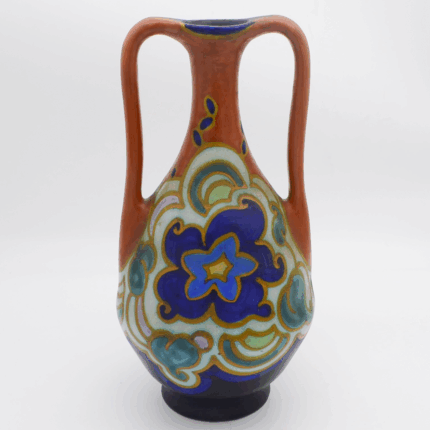
Jug with handles, decor ‘Flora’, Zenith, Gouda
€ 200,00A distinctive jug featuring pastel hues with warm orange accents, designed in a matte Art Deco style. Produced by Zenith, a renowned pottery manufacturer that began as a pipe-making factory in 1749 before transitioning to creating Plateel art pieces in 1918. Zenith’s matte floral designs quickly became a hallmark of their artistry, offering strong competition to other Gouda-based factories.
This piece exemplifies the innovative craftsmanship and aesthetic appeal that defined Zenith’s contributions to decorative ceramics.
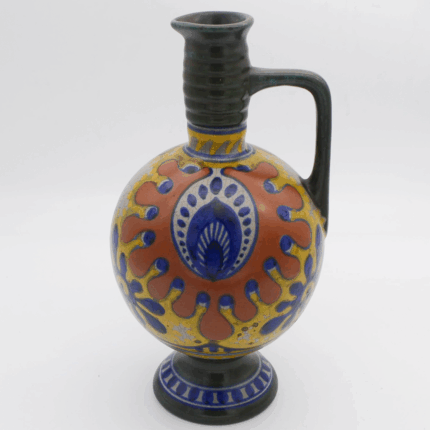
Jug, decor ‘Rhodian’, Zuid-Holland, Gouda
€ 175,00Beautiful example of a dark green colored Art Deco Matte jug, produced in 1922. The Middle Eastern inspired Rhodian decors were developed in the 1910s and went on to become a world-wide bestseller. Plateelbakkerij Zuid-Holland became the biggest pottery in Gouda and made more decorative pieces than any other Dutch producer.
The signature on the bottom showcases the artist, year and factory marks.

Plate, decor ‘Atol’, Zuid – Holland, Gouda
€ 225,00A ceramic plate featuring a rare design of black tulips in an Art Nouveau style. The intricate patterns and matte finish reflect the early 20th-century transition into Art Deco. The combination of vibrant colours and soft pastel tones adds depth to the piece.
The plate includes markings on the underside, showing the artist’s initials (Baukje Kwinkelenberg), the Zuid-Holland factory mark, the production year, and the decor name.

Traditional Houses – Makkum – 1980s
€ 150,00A beautifully crafted pair of Makkum tiles featuring detailed depictions of traditional Dutch houses in classic Delft blue and white. The designs are hand-painted on a white tin-glazed surface, resulting in vivid colours and a smooth, glossy finish.
These tiles were produced by Tichelaar pottery in Makkum during the 1980s. With a history dating back to 1572, Tichelaar was renowned for its exceptional craftsmanship and dedication to traditional techniques, preserving the rich ceramic heritage of Friesland. As tile production ceased in 2013, this pair offers a charming and authentic glimpse into Dutch artistry and culture.

Dutch Port – Makkum – 1990s
€ 90,00A beautifully crafted Makkum tile featuring a detailed Dutch port scene in classic Delft blue and white, complemented by brown-toned colouring. The design is hand-painted on a white tin-glazed surface, resulting in vivid colours and a smooth, glossy finish.
This tile was produced by Tichelaar pottery in Makkum, a family-run factory with a history dating back to 1572. Renowned for its exceptional craftsmanship and dedication to traditional techniques, Tichelaar preserved the rich ceramic heritage of Friesland for centuries. As the factory ceased tile production in 2013, this piece stands out as a rare collectable.

Large Vase, Zuid-Holland, Gouda
€ 950,00Exceptionally beautiful, large and rare vase in the Dutch Art Nouveau style, featuring a 360-degree peacock design. Made by Plateelbakkerij Zuid-Holland, the largest pottery in Gouda at the time, this vase represents the colourful matte-glaze decor typical of their work between 1900 and 1924.
The carved year mark on the base dates this piece to 1900, during the factory’s early period of decorative experimentation, when the year marks were still carved instead of painted on the bottom.
There are minor signs of wear on the glaze layer, appropriate for its age.

Pedestal Bowl, Nieuw-Rozenburg, Den Haag
€ 175,00This beautiful, dark colored pedestal bowl was created by the Nieuw-Rozenburg factory in The Hague.
Nieuw-Rozenburg only existed for a few years. It was established in 1919 by Rudolf Sterken, a former employee of the famous Rozenburg factory (1883-1917), that gained international acclaim for its exceptional ceramics, particularly during the Art Nouveau period.
Despite of the excellent quality of the Nieuw-Rozenburg designs, the factory was commercially unsuccesful. It had to close its doors in 1923.
This rare bowl is in excellent condition, with a very small chip on the rim.

Vase Set, decor ‘Mat Vogels’, Zuid-Holland, Gouda
€ 800,00This set, designed by Willem Hartgring and painted by Karel van de Heuvel, is a remarkable example of Dutch Art Nouveau ceramics and a testament to the craftsmanship and artistry that defined PZH’s plateel production. Sets like this are rare.
After leaving Rozenburg, Willem Hartgring brought his innovative techniques and designs to Plateelbakkerij Zuid-Holland (PZH), where he greatly influenced production between 1907 and 1920. Drawing from his experience at the renowned Rozenburg factory, Hartgring introduced the NP (New Porcelain) decors, which featured detailed floral motifs in bright colours on a white background. Initially finished with a thin, glossy transparent lead glaze, these pieces took on a distinctive matte appearance after the introduction of a perfected matte glaze in 1910.
The matte NP pieces, often referred to as Mat Vogels (MV) and Mat Bloemen (MB), showcased soft, chalky hues that quickly gained popularity. MV decors frequently included parrot motifs, which peaked in popularity around 1907 but continued to be produced into the 1920s.
The condition is excellent aside from one very thin scratch on one of the vases’ neck interiors.
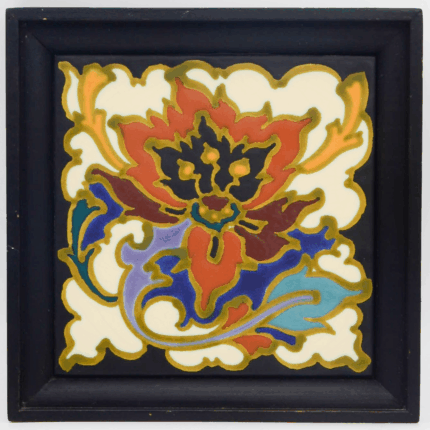
Flower tile, decor ‘Rosario’, Regina, Gouda
€ 95,00This beautiful tile, crafted by the renowned Regina factory in the 1920s, is an example of early 20th-century Dutch ceramic artistry. Featuring intricate hand-painted designs, it showcases the bold colours and detailed patterns characteristic of the Plateel style.
The tile’s vibrant matte glaze and meticulous craftsmanship reflect the creative vision of the Regina factory, a significant name in Dutch ceramics during the early 20th century. A fine piece that comes with its original frame and factory marks on the bottom. The condition is excellent, with only a few scratches on the wooden frame.

Large Lidded Vase – Royal Delft – 1957
€ 475,00This large lidded vase by Royal Delft was produced in 1957 and features a classic design that has been in production for decades and continues to be made today. The bottom is marked with the factory stamp, confirming its authenticity.
The vase is in very good condition.

Small Wall Plate, decor ‘Danier’, Zuid-Holland, Gouda
€ 100,00This striking matte wall plate, crafted in 1924, features the Danier matte glaze pattern. A stunning example of blue-toned Art Deco ceramics, it retains its original form and elegance, showcasing the timeless appeal of Plateelbakkerij Zuid-Holland’s craftsmanship.
As the largest pottery in Gouda, Plateelbakkerij Zuid-Holland dominated the market with its decorative pieces, producing more than any other manufacturer. Their darker, stylised floral high-glaze patterns, a hallmark of their artistry, were crafted between 1900 and 1924.
This piece bears factory marks, the artist’s signature, and the year of production on its base. The plate is in perfect shape after more than 100 years since its production.

Jug with handle, Mobach, Utrecht
€ 140,00Klaas Jan Mobach founded Mobach Keramiek in 1895, establishing a family-run ceramic workshop in Utrecht, Netherlands. Originally known as the Utrechtse Pottenfabriek, Mobach Keramiek has become renowned for its handcrafted vases and pots, distinguished by their innovative designs, exceptional quality, and blend of traditional techniques with modern influences.
Ceramic vase no. 746 is a notable example of Mobach Keramiek’s craftsmanship. Designed by Klaas Jan Mobach in the 1930s, this piece embodies the geometric shapes, bold lines, and contrasting colours that define the Art Deco style of the era. The vase’s elegant design and meticulous hand-finishing reflect the artistic vision and attention to detail for which Mobach is celebrated.
Made from high-quality earthenware, the vase bears the number 746 and “Mobach Utrecht” engraved on its base, confirming its authenticity and origin. It is in good condition despite its age, with small chips on the rim.

Small Wall Plate, decor ‘Rhodian’, Zuid-Holland, Gouda
€ 100,00This striking matte wall plate, crafted in 1924, features the renowned Rhodian matte glaze patterns designed by Daniël Harkink and L.J. Müller around 1908.
Inspired by Middle Eastern designs, the Rhodian decors became an international sensation and a best-seller, solidifying the factory’s reputation. As the largest pottery in Gouda, Plateelbakkerij Zuid-Holland dominated the market with its decorative pieces, producing more than any other manufacturer. Their darker, stylised floral high-glaze patterns, a hallmark of their artistry, were crafted between 1900 and 1924.
This piece bears factory marks, the artist’s signature, and the year of production on its base. The plate is in perfect shape after more than 100 years since its production.
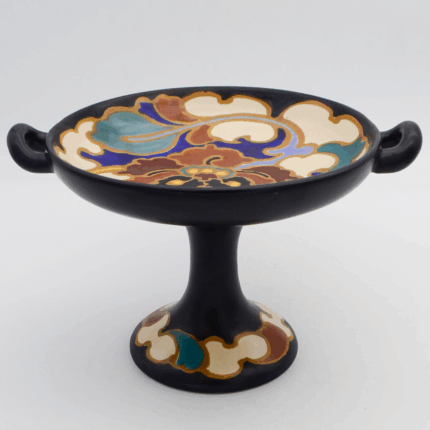
Pedestal Bowl With Handles, decor ‘Rosario’ , Regina, Gouda
€ 200,00This exquisite Plateel pedestal bowl, crafted by the renowned Regina factory in the 1920s, is a stunning example of early 20th-century Dutch ceramic artistry. Featuring a graceful pedestal base and beautifully hand-painted designs, it showcases the bold colours and intricate patterns characteristic of the Plateel style.
The bowl’s elegant form and vibrant glaze reflect the craftsmanship and creative vision of the Regina factory, a significant name in Dutch ceramics during the early 20th century. A fine piece that bridges functionality and artistic heritage.
The condition is perfect.

Standard-bearer | +/- 1680
€ 400,00This antique Delft tile features a depiction of a 17th-century standard-bearer (vaandrig), a figure of great significance in the Dutch army of the time. The standard-bearer was entrusted with the vital task of carrying the company’s flag—a symbol of honour, unity, and identity—making them a central figure on the battlefield.
This role, while prestigious, came with immense risk, as their exposed position often made them a target. Carrying the standard required both hands, leaving them without firearms; however, they were typically equipped with a small sword or rapier for self-defence.
Hand-painted in traditional cobalt blue on white tin glaze with the classic ‘ox head’ motif, this tile beautifully captures the historical essence and artistic finesse of Delftware. It serves as a tribute to the bravery and symbolism embodied by the standard-bearer.
In good condition for its age, with small signs of wear, this tile is a remarkable piece of history and a valuable addition to any collection of antique ceramics or military-themed art.

Merman Cupid | +/- 1660
€ 500,00This rare and enchanting antique Delft tile features a unique depiction of a half-merman, half-angel Cupid poised with his bow and arrow. Blending mythological and ethereal elements, this striking motif symbolises love’s transformative and transcendent power, making it a true conversation piece.
Hand-painted in classic cobalt blue on a white tin-glazed surface, the craftsmanship reflects the finest traditions of 17th-century Dutch Delftware. The design captures the artistry and creativity of its era. Originally crafted as a functional and decorative piece for Dutch homes, this tile now stands as a rare and collectable artefact.
Despite its age, the tile remains in good overall condition, with light wear and refurbishing work consistent with its history. This one-of-a-kind piece is perfect for collectors, art enthusiasts, or anyone seeking a distinctive addition to their home or collection of historical ceramics.

Child Without a Flag | +/- 1650
€ 450,00This antique Delft tile features the charming and iconic ‘Kind zonder Vlag’ (Child Without a Flag) motif, a beloved design from 17th-century Dutch tile-making traditions. The hand-painted cobalt blue illustration depicts a child holding his hand up, pretending holding a flag, symbolising innocence and simplicity, while reflecting the playful spirit of childhood.
Framed by elegant ‘ox-head’ corner motifs, this tile embodies the timeless artistry of Delftware, with its classic blue-and-white palette and attention to detail. Originally used as a decorative and functional element in Dutch homes, this piece has endured as a symbol of cultural heritage and craftsmanship.
In good condition for its age, with minor wear that enhances its antique charm, this tile is a rare find and a perfect addition to any collection of historic ceramics or Delftware art.

Cupid | +/- 1700
€ 175,00This antique Delft tile features a striking and thought-provoking depiction of Cupid appearing to be struck by an arrow, evoking themes of love, vulnerability, and romantic longing. Crafted around the year 1700, this tile showcases the timeless artistry of Delftware, with its intricate design rendered in classic cobalt blue on a white glaze. The piece is further adorned with elegant ‘spider’ corner motifs.
Despite its age, the tile remains in good condition, with minor wear that only enhances its antique charm—a rare and meaningful addition to any collection.

Wall Plate, decor ‘Imari’ – Royal Delft – 1974
€ 180,00Beautiful wall plate in ‘Imari’ style, produced in the 1970s.
The name and style of this decoration refer to the famous Japanese ‘Imari-ware’, which was exported in large quantities from Japan to the Netherlands in the second half of the 17th century.
The plate is in perfect condition.

Milk Jug – Royal Delft – 1972
€ 225,00A stunning bellied jug adorned with intricate bird and floral motifs, crafted by the renowned Royal Delft (Koninklijke Porceleyne Fles).
Impeccably preserved, it is in perfect condition with no chips or cracks.

Dog | +/- 1640
€ 250,00This tile dates back to approximately 1640 and is quite rare due to its unique design. It features a blue ‘ox-head’ corner motif paired with a polychrome central scene depicting a large dog. The large size of the ‘ox-head’ motif and the thickness of the tile are indicators of its remarkable age.
The tile is in overall good condition, with a small chip on the top side and slight baking imperfections on the left side corner motifs. Restoration work can also be seen on a line in the middle of the title.

Flower pot, decor ‘Pensee’, Arnhemsche Fayencefabriek, Arnhem
€ 180,00This is a beautiful example of Art Nouveau pottery with Japanese flower inspiration.
The Arnhemsche Fayencefabriek was a well-known Dutch factory at the time when plateel boomed in Gouda. The factory gained appreciation through the works of the famous Willem Hartgring who came to work here after previous assignments at Rozenburg (The Hague) and Zuid-Holland (Gouda). Hartgring’s Japanese styled birds and flower motifs belong to the best work in this genre that has ever been created in the Netherlands.
The factory’s rooster mark, decor, model and painter marks can be found at the bottom of the vase.
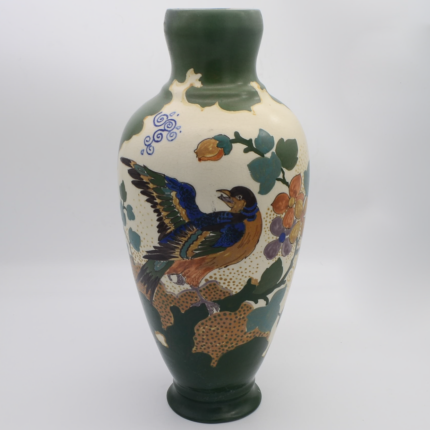
Large Vase, decor ‘Vogel’, Arnhemsche Fayencefabriek, Arnhem
€ 500,00Stunning, rare vase with a decor designed by W. Hartgring for Arnhemsche Fayencefabriek.
The Arnhemsche Fayencefabriek was a well-known Dutch factory at the time when plateel boomed in Gouda. The factory gained appreciation through the works of the famous Willem Hartgring who came to work here after previous assignments at Rozenburg (The Hague) and Zuid-Holland (Gouda). Hartgring’s Japanese styled birds and flower motifs belong to the best work in this genre that has ever been created in the Netherlands.
The factory’s rooster mark, decor, model and painter (JvN) marks can be found at the bottom of the vase.

Wall plate ‘Decor Breetvelt’, Plateelbakkerij Zuid-Holland, Gouda
€ 250,00Beautiful Art Deco wall plate, designed by Henri Breetvelt, and painted by Gerrit Pieter van den Akker.
Henri Breetvelt (1864-1923) was nicknamed by his peers ’the king of pottery painters’. His designs were pathbreaking and highly influential. His work is represented in various Dutch museums.
His designs continued to bee prodcued after his death under the name “Decor Breetvelt”.

Wall plate, decor ‘Flash’, De Pauw
€ 325,00Delicate polychrome wall plate with famous ‘flash’ decor, second half of 17th century.
The plate has been refurbished and has wear marks according to age and use.

Two-piece fruit tray, De Porceleyne Byl, Delft
€ 450,00A beautiful set with impressive painted decor from the 18th century. Delicately detailed fruit plate with matching drain tray.
The condition of both pieces is very good, considering they have survided for 250 years (which is rare for this kind of pieces). Notable wear signs according to age and usage.

Large polychrome wall plate
€ 450,00Large wall plate, multicolor, with china-themed design.
This early piece is particularly interesting because of old restorations: the clamps at the back of the plate testify to the ancient craft of pottery repair, from an era when decorated high-end earthenware was valuable and used for generations.
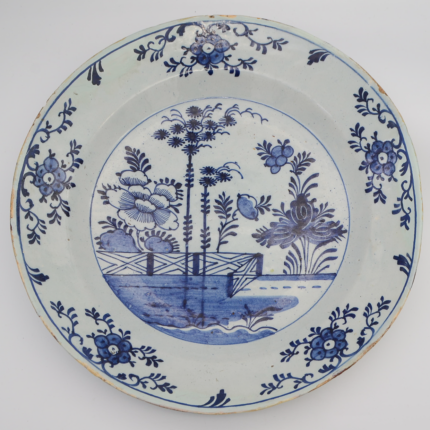
Large wall plate
€ 425,00Elegant large wall plate, with decoration of traditional Chinese garden. An example of Chinese inspired old delftware in excellent condition for being over 300 years old.
Small ware such as chips along the rims can be spotted, according to age and use.

Wall plate ‘Decor Breetvelt’, Plateelbakkerij Zuid-Holland, Gouda
€ 350,00Beautiful Art Deco wall plate, designed by Henri Breetvelt, and painted by M. Burger.
Henri Breetvelt (1864-1923) was nicknamed by his peers ‘the king of pottery painters’. His designs were pathbreaking and highly influential. His work is represented in various Dutch museums.
His designs continued to be produced after his death under the name “Decor Breetvelt”.

Flower Pot Wall Plate – Royal Delft – 1947
€ 195,00This stunning Delft Blue plate was created by the skilled artisans of Royal Delft. Hand-painted, this large wall plate showcases a Dutch flowerpot as the central piece.
The condition of the plate is excellent, like new.

Wall Plate with Bird – Royal Delft – 1930
€ 395,00This stunning large Royal Delft plate features a flying bird in a floral design.
After almost 100 years the plate is still in excellent condition.

Very Large Wall Platter – Royal Delft – 1950
€ 490,00Beautiful large wall plate, with lobbed shape and deep blue colour palette.

Large Belly Vase – Royal Delft – 1953
€ 375,00This Royal Delft vase, delicately painted, is a unique piece that is no longer produced by the factory.
The factory mark, artist’ signature and year can be found on the bottom. The vase is in perfect condition.
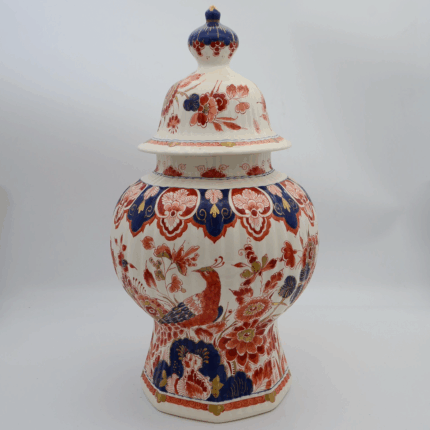
Large Lidded Vase, decor ‘Imari’ – Royal Delft – 1973
€ 500,00Large vase in ‘Imari’ style, produced in the 1970s.
The name and style of this decoration refers to the famous Japanese ‘Imari-ware’, that was exported in large quantities from Japan to the Netherlands in the second half of the 17th century.
The painting is particularly well executed, and over 50 years on the vase is still in pristine condition.
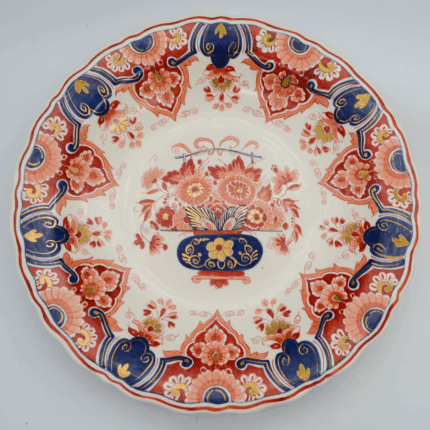
Wall Plate, decor ‘Imari’ – Royal Delft – 1973
€ 200,00Beautiful wall plate in ‘Imari’ style, produced in the 1970s.
The name and style of this decoration refer to the famous Japanese ‘Imari-ware’, which was exported in large quantities from Japan to the Netherlands in the second half of the 17th century.
The condition is perfect.

Pair of large Vases, decor ‘Rosario’, Regina, Gouda
€ 650,00Set of ‘Rosario’ vases.
The famous ‘Rosario’ decors was designed by Steef Broers in the late 1920s and has been produced by Regina for over 50 years. This early set can be dated around 1930. Unlike later production, this model is entirely hand-painted (with painter’s signature). Both vases are in pristine condition.

Large Lidded Vase, Plateelbakkerij Zuid-Holland, Gouda
€ 575,00Colorful large vase with lid, Flambé decor, in Art Nouveau style.
Plateelbakkerij Zuid-Holland went on to become the biggest pottery in Gouda and made more decorative pieces than any other. Their high-glaze decors, in darker stylised floral decors were produced from 1900 to 1924. According to the year mark, this model was made in 1918.
A very small chip can be seen at the bottom of the vase, however it does not affect the balance and it cannot be spotted.

Large Lidded Vase, Boch Keramis, Belgium
€ 275,00Delft Blue decor, produced by Boch Keramis, with a beautiful Chinese-themed design.
This is a fine example of the worldwide appeal of Delftware. In 1874 the reputed Belgian company Boch Keramis set up its ‘chambre des peintres Hollandais’, where handpainted Delft style products were produced by Dutch painters hired from Delft and Maastricht. This vase is a testimony of the remarkable quality of this production. By the year 1900 the chambre was closed, due to the increasing competion from industrially produced pottery.
The factory signature can be found on the bottom. The condition is good with a chip under the lid and normal signs of wear.

Farmer | +/- 1680
€ 95,00Interesting tile showing a farmer with a rake. Or perhaps a fisherman with a harpoon?
Antique tiles were made from stories, and in turn led to new storytelling. Often, the most interesting tiles are those that are ambiguous. This one is a great example.
With ‘spider’ corner motives. The condition is very good for such an old tile, with a few minor spots visible.

Landscape | +/- 1780
€ 75,00This tile shows a house and a church surrounded by fields and boats. For the average 18th century Dutchman this scene represented the pinnacle of earthly success. The tile is painted with manganese pigment.

Dutch House | +/- 1750
€ 85,00This tile shows a house with a smoking chimney, amidst fields and water.